
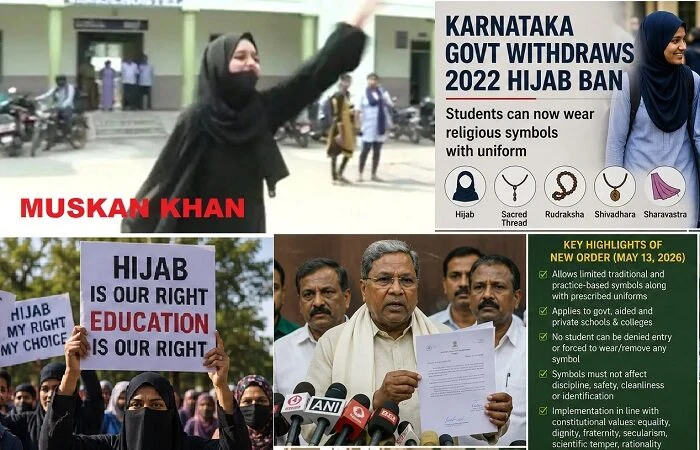


Karnataka Congress led government’s decision to revoke the 2022 hijab restriction has reopened an important debate, not merely about uniforms in classrooms, but about the meaning of religious freedom, pluralism, and the Islamic understanding of hijab itself.
Now, with the Congress-led government officially reversing that order and allowing students to wear religious symbols along with uniforms, the debate has shifted from prohibition to accommodation. However, every person should clearly understand that what exactly does hijab mean in Islam, and why do many Muslim women consider face covering to be part of their religious obligation?
For true Muslims, hijab is not merely a cultural identity marker or optional dress preference. It is understood as a command rooted in divine revelation. The Qur’an repeatedly instructs believing women to observe modesty and conceal their adornment before unrelated men. In Surah An-Nur (24:31), women are instructed to draw their khimar (veil or covering) over their bosoms, while Surah Al-Ahzab (33:59) commands believing women to draw their outer garments closely around themselves so they may be recognized as respectable and protected from harm.
Classical Islamic scholars did not interpret these verses as referring only to a loose headscarf. Rather, many understood hijab as a broader system of modesty involving concealment of beauty, adornment, and attraction in public life. This is why throughout Islamic history, especially in scholarly practicing families, face covering was often considered either obligatory or strongly recommended.
A major argument advanced by classical scholars is that the face is naturally the center of beauty and attraction. If the purpose of hijab is to reduce public display of beauty and maintain modest interaction between genders, then excluding the face from hijab appears inconsistent with that objective. Based on this reasoning, nearly all classical jurists argued that complete hijab includes covering the face, particularly in environments where temptation, public mixing, or social corruption are prevalent.
Among the most influential modern scholars who defended it was Maulana Abul A’la Maududi. In his extensive writings on purdah and Islamic civilization, Maulana Maududi argued that the Qur’anic concept of hijab was never limited to covering the hair alone. According to him, the purpose of hijab in Islam is the protection of modesty and the creation of a morally disciplined society, and this objective is most fully realized through covering the face as well.
Maududi cited Qur’anic verses, Hadith narrations, and the practices of the wives of the Prophet Muhammad ﷺ and female companions to support his position. He particularly emphasized that the women of the Prophet’s household practiced strict veiling before unrelated men and that many narrations indicate that women during the Prophet’s era would cover their faces in public spaces.
Supporters of face covering also refer to narrations from the companions and early Islamic generations where women concealed their faces during travel, pilgrimage, and interaction with non-mahram men. While scholars differed over whether face covering is absolutely mandatory in every circumstance, the overwhelming majority of them established it obligatory.
This is why many Muslims strongly objected when courts or political authorities attempted to define hijab narrowly as a non-essential or merely symbolic practice. Critics argued that secular institutions lack theological authority to reinterpret centuries of Islamic scholarship. From their perspective, when millions of Muslim women across different cultures and generations have consistently regarded hijab — including face covering — as part of religious obedience, dismissing it as non-essential appears disconnected from lived Islamic tradition.
The educational consequences of the 2022 restriction during BJP govt in the state also became a major concern. For many Muslim families, hijab and niqab are matters of conscience and religious duty. When students were effectively forced to remove them to enter classrooms, some families chose withdrawal from institutions over compromise. Supporters of the new Karnataka policy argue that education should not require students to abandon sincerely held religious beliefs.
The revised order therefore represents more than administrative reform. It signals a broader recognition that pluralism in India cannot mean erasing visible religious identities. Just as Sikhs are permitted turbans and Hindus may wear sacred symbols, Muslim women too seek the right to observe what they understand as their religious obligations without exclusion from public education. Genuine equality does not require suppressing faith. Instead, equality means ensuring that students from different religious backgrounds can participate in education with dignity while remaining faithful to their beliefs.
Ultimately, the Karnataka reversal highlights a fundamental question: should the state impose a single model of appearance in the name of uniformity, or should it accommodate peaceful religious practices within educational institutions?