
36.1 C
New Delhi
Saturday, May 16, 2026

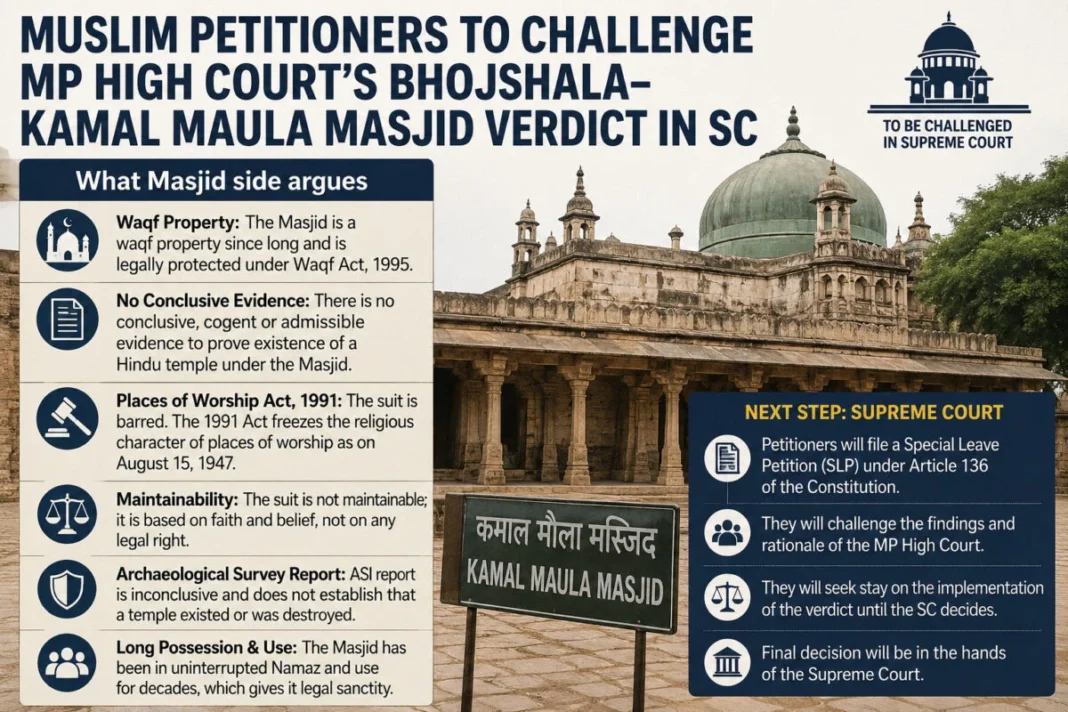
Muslim Petitioners to Challenge MP High Court’s Bhojshala-Kamal Maula Masjid Verdict in SC;What Masjid side argues

Must read

Indore: Rejecting the Madhya Pradesh High Court’s ruling that declared the 11th-century Bhojshala-Kamal Maula Masjid complex a Saraswati temple, the Muslim side has  announced immediate plans to challenge the decision in the Supreme Court.

The Indore bench of the High Court on Friday quashed a decades-old April 2003 order by the Archaeological Survey of India (ASI) that had permitted Muslims to offer namaz on Fridays and Hindus to worship on Tuesdays. In a 242-page order, the bench of Justices Vijay Kumar Shukla and Alok Awasthi suggested the state government allocate separate land in Dhar district for a mosque instead. The bench “In order to secure the religious rights of the Muslim community and to ensure complete justice between the parties……the State Government may consider (an application for land) in accordance with law for allotment of a suitable and permanent part of land in Dhar district to the Muslim community, which may be represented either through…..a duly constituted Waqf body for the construction, administration of a mosque and associated religious facilities.”

Giving example of Babri case, HC bench said “We have considered the archaeological, historical facts, ASI notifications and survey report on the anvil of the statutory provisions of the ASI Act as well as on the basis of the principles laid down in the Ayodhya case, that archaeology is a science that draws on multidisciplinary or transdisciplinary approaches and considering the nature of archaeological evidence.”

“Flawed” Survey and Jurisdictional Objections

Ashar Warsi, counsel for the Muslim petitioners, stated that they are entirely unsatisfied with the 242-page judgment, labeling the ASI’s 98-day scientific survey report—upon which the court heavily relied—as “flawed.”

Warsi also raised a critical jurisdictional objection, arguing that a matter involving highly disputed historical facts should not have been adjudicated through a writ petition under Article 226 of the Constitution. Instead, he maintained, it belongs in a civil court, noting that the Muslim side has already filed a lawsuit in a Dhar civil court.

Owaisi Cites Historic Protections and 1991 Act

All India Majlis-e-Ittehadul Muslimeen (AIMIM) president Asaduddin Owaisi strongly condemned the judgment, asserting that the site has functioned as a mosque for 700 years and is a “waqf by dedication.”

Owaisi argued that the High Court erroneously ignored several critical historical and statutory protections:

  • The Places of Worship Act, 1991: This law explicitly states that the religious character of any place of worship cannot be altered from what it was on August 15, 1947.
  • Historical Gazetteers: The 1935 Dhar State Gazette officially acknowledged the site as a mosque relinquished to the Muslim community.
  • Past ASI Records: Official ASI clarifications from 1951 and 1952 maintained its status as a mosque.

“I feel that the Government of India, the Modi government, and the ASI are acting in tandem with the petitioners,” Owaisi alleged, drawing “glaring similarities” between this case and the Babri Masjid dispute.

Reactions and Next Steps

Shahar Qazi Waqar Sadiq confirmed that a formal appeal to the apex court will be filed after a thorough review of the full judgment. Meanwhile, a Hindu petitioner, Jitendra Singh ‘Vishen’, has already filed a caveat in the Supreme Court requesting that no orders be passed without hearing their side first.

Commenting on the development, Congress Rajya Sabha MP and former Chief Minister Digvijaya Singh stated that the Supreme Court must now ultimately decide whether active worship can even be permitted inside an ASI-protected monument. Singh noted that the ruling comes at a time of “economic and social crisis,” adding that it is inappropriate to escalate communal issues when multiple related disputes—including Gyanvapi and Mathura—are already pending before the apex court.

2003 ASI Order

The Director General of the Archaeological Survey of India (ASI) had issued an order on April 7, 2003 under Rule 4 of the Ancient Monuments and Archaeological Sites and Remains Rules, 1959, partially modifying the notification dated 05.02.1998 regarding access to the Bhojshala–Kamal Maula Mosque complex in Dhar. As per the order, the Muslim community was allowed access for Friday namaz between 1 and 3 pm, while Hindus were permitted to perform traditional ceremonies on Basant Panchami and to access the site every Tuesday from sunrise to sunset, with limited offerings such as flowers and rice grains allowed.

Muslims side Submissions in the court

Senior Advocate Salman Khurshid, appearing for the Muslim side, relied heavily on the Supreme Court judgment in M. Siddiq (D) Thr. Lrs. vs Mahant Suresh Das & Ors (Ayodhya case, 2020) to argue that archaeological findings and ASI reports cannot determine title or ownership. He submitted that even if ASI evidence suggests the existence of an earlier structure, ownership must be decided strictly on legal principles, tested evidence, and civil trial, not on historical inference or faith-based claims. He emphasized that historical accounts, belief, or archaeological interpretation cannot substitute admissible evidence and cross-examination. Relying on key paragraphs of the Ayodhya judgment, he argued that disputes over immovable property must be resolved on the basis of possession, continuous use, and legally proven ownership under the balance of probabilities. He also stressed that faith or intermittent worship alone cannot establish legal title. He further contended that the Places of Worship Act, 1991 freezes the religious character of a site as on 15 August 1947 and prevents reopening of historical disputes. According to him, even ASI-related exclusions do not permit re-litigation of religious character or ownership claims.He also argued that juristic personality applies only in limited legal contexts and does not convert land itself into a legal person based on belief. The Supreme Court, he said, rejected the idea that land can be treated as a deity or that faith alone can establish legal rights. Concluding his submissions, he maintained that archaeological or historical materials are not conclusive proof of title, and that issues of ownership and possession require detailed evidence in a civil trial. He therefore argued that the writ petitions are not maintainable and sought their dismissal.

Advocate N. A. Sheikh, appearing as an intervenor for the Muslim side, submitted that the historical title of the property stemmed from sanads and royal grants, under which all land vested in the ruler and rights were conferred through formal grants. He argued that documents relied upon show the land was granted for mosque and dargah purposes by rulers such as Mohammed Shah Badshah and subsequent authorities, establishing the lawful origin of possession.

He further submitted that records indicate continuity of religious administration through descendants associated with Baba Nizamuddin and Kamaluddin Chishti, with imams and caretakers performing religious functions for centuries. Revenue records and khasra entries, he argued, also describe the site as a mosque and dargah, reflecting long-standing official recognition.

He contended that there was no acquisition under the ASI Acts of 1904, 1951, or 1958, and therefore pre-existing rights were never lawfully extinguished. In the absence of valid acquisition, he argued, historical rights continue to subsist.

He also submitted that archaeological findings or ASI reports have limited evidentiary value in determining title and cannot substitute proof in a civil court. He argued that under the Ancient Monuments and Archaeological Sites and Remains Act, 1958, rights of persons in religious charge are protected, and the intervenors, being in such charge, cannot be deprived of access or control without their consent.

Concluding his submissions, he argued that the intervenors have established long-standing possession and use, supported by historical records and continuous religious activity, whereas the opposing claims are based primarily on faith and historical assertion without proof of possession or legal entitlement. He therefore sought dismissal of the petitions.

Advocate Syed Ashar Ali Warsi, appearing for the intervenors in WP No. 10497/2022, raised preliminary objections similar to those of other Muslim-side counsel, arguing that the writ petition involves disputed questions of fact and is therefore not maintainable, with the proper remedy lying before a civil court.

He contended that the dispute relates to the composite property comprising Khasra Nos. 313 and 314, which forms part of the notified premises, and that attempts to reinterpret or segregate its character are contrary to existing records. He further argued that the petition is barred under Sections 4, 5, and 6 of the Waqf Act, 1995, as the statutory survey and notification of waqf properties have already attained finality.

He submitted that Section 6 provides that disputes regarding waqf status must be raised before a competent civil court within the prescribed limitation period, and that challenges made decades later are barred by limitation. He also argued that statutory mechanisms cannot be bypassed by invoking writ jurisdiction, and that once notifications attain finality, rights stand crystallised.

He emphasised that the Archaeological Survey of India (ASI) functions only as a custodian and not as an owner, and therefore cannot alter the religious character of a protected monument. He added that official records, gazette notifications, and historical documents consistently describe the structure as a mosque, carrying strong evidentiary value unless properly rebutted.

He further submitted that the structure contains features such as qibla orientation, mihrab, minbar, and ablution areas, which support its long-standing use as a mosque. He rejected claims that it was originally a temple, arguing that such assertions are unsupported by continuous legal or historical evidence.

Adopting submissions of senior counsel, he maintained that ASI reports are not conclusive on title or religious character, and concluded that the writ petition is barred by limitation, not maintainable, and must be dismissed, with parties directed to pursue remedies before the competent civil court.

The petitioner society, Maulana Kamaluddin Welfare Society Dhar, represented through its President Abdul Samad Khan, stated that it is a registered society under the M.P. Societies Registration Adhiniyam, 1973, and its objective includes protection of the Bhojshala–Maulana Kamal Masjid complex at Dhar. It was submitted that the society has been duly approved by the competent Registrar.

The petitioner contended that the Bhojshala–Maulana Kamal Masjid is a registered Waqf property, notified under relevant State Gazette notifications, and historically recognised as a mosque/dargah. It was also pointed out that earlier government notifications, including those of 1935 and 1985, described the property in religious terms consistent with Muslim usage.

Reliance was placed on a consent arrangement of 1995, under which limited access was permitted to both communities under specified conditions. It was submitted that subsequent breaches of these conditions led to law and order issues, after which administrative directions were issued regulating access, including the Collector’s order permitting Friday namaz and Basant Panchami observances.

The petitioner further referred to orders issued by the Archaeological Survey of India in 1998 and 2003 regulating entry and maintenance of order within the protected monument. It was argued that despite repeated representations, authorities failed to enforce compliance with these directions, leading to continued disputes and incidents of tension.

Instances of alleged violations, harassment, and communal disturbances were also placed on record, supported by media reports and representations to authorities. The petitioner submitted that these events demonstrate failure of enforcement of binding administrative directions governing the site.

Counsel Tausif Warsi argued that earlier writ petitions were limited in scope, primarily seeking implementation of ASI directions and maintenance of peace, without adjudicating title or exclusive rights. He submitted that subsequent petitions had expanded reliefs improperly, including claims relating to idol installation and retrieval of alleged idols abroad.

He further contended that claims regarding the Saraswati idol were factually incorrect, relying on British Museum clarification identifying the sculpture as Goddess Ambika, not Saraswati. He also argued that historical and archaeological material does not establish temple demolition or conversion, and that ASI reports and early surveys instead consistently describe the structure as a mosque with mixed architectural elements.

It was submitted that historical evidence shows layered cultural use of the site but does not conclusively support claims of conversion from a temple. Revenue records, ASI reports, and historical surveys were cited to show continuous recognition of the structure as a mosque/dargah.

Counsel also argued that petitioners’ case is based largely on assumption and interpretation rather than legally admissible proof of demolition or conversion. He submitted that even extensive historical literature does not establish the foundational facts required to support their claim.

He further pointed out that over 125 years of official records consistently describe the site as a mosque, and that no authoritative document records it as a Saraswati temple. On this basis, he supported dismissal of the petition and adopted the submissions of senior counsel regarding maintainability and jurisdictional issues.

Advocate for the writ appellants, Qazi Zakullah & Ors., filed the petition in a representative capacity on behalf of the Muslim community of District Dhar, invoking Articles 14, 25 and 26 of the Constitution, along with provisions of the Ancient Monuments and Archaeological Sites and Remains Act, 1958 and the Places of Worship (Special Provisions) Act, 1991.

It was submitted that the petitioners have an established constitutional right under Article 25 to perform religious practices, including Friday namaz at the Kamal Maula Masjid, Dhar, which has allegedly been obstructed due to the ASI orders dated 07.04.2003. The petitioners claimed that these rights are supported by documentary evidence and earlier judicial proceedings.

Rejoinder submissions on ASI report and factual disputes

Counsel Tausif Warsi, in rejoinder, challenged the Archaeological Survey of India (ASI) report, arguing that it lacked scientific reliability. It was submitted that despite court directions, proper scientific dating methods such as carbon dating, OSL, and thermoluminescence were not carried out.

He contended that conclusions regarding antiquity and structure were based on artefacts and surface-level surveys, which are insufficient to determine chronology. He further argued that tools such as total station survey, GPR, and XRF analysis cannot establish historical dating.

Serious objections were raised regarding alleged recovery of artefacts, including claims that the excavation area was previously used for storage and contained modern waste, thereby casting doubt on authenticity. It was also alleged that proper excavation videography and inventory records were not maintained or disclosed.

He further submitted that some artefacts were collected from areas outside the core structure, making them irrelevant for determining the character of the disputed site. The ASI process was alleged to be methodologically defective, non-neutral, and influenced by external narratives.

Counsel argued that architectural features such as west-facing orientation and water tank are consistent with mosque design and do not support the claim of a temple. He further submitted that petitioners failed to establish any temple existence, demolition, or conversion with credible evidence.

Rejoinder submissions on legal and historical interpretation

Advocate Syed Ashar Ali Warsi, for intervenors, submitted that the 1935 Dhar State notification continues to have legal force under constitutional provisions preserving pre-Constitution laws, including Article 372. Reliance was placed on judicial precedent affirming continuity of such instruments.

He argued that official records consistently recognize the site as a mosque, and no lawful order has ever extinguished that status.

He also alleged lack of neutrality on the part of the State and ASI, contending that both authorities acted inconsistently and in violation of constitutional principles of fairness and equality under Articles 14 and 12.

On historical interpretation, he submitted that reuse of architectural materials was common in medieval India and does not imply temple demolition. He disputed claims of forced conversion, stating that historical evidence instead reflects reconstruction over earlier ruins.

He further argued that the idol relied upon by petitioners was not recovered from the disputed site, weakening claims of temple association.

He also submitted that inscriptions and literary references cited by petitioners do not conclusively prove temple character, as such material may equally indicate educational or mixed-use historical activity.

More articles

LEAVE A REPLY

Please enter your comment!
Please enter your name here

Latest article