


Malik Ashtar
Among the journalists who have emerged from Delhi’s Urdu media over the past two decades, I consider Mohammad Alamullah a distinctive figure. While many qualities set him apart, the most important is the versatility of his pen.
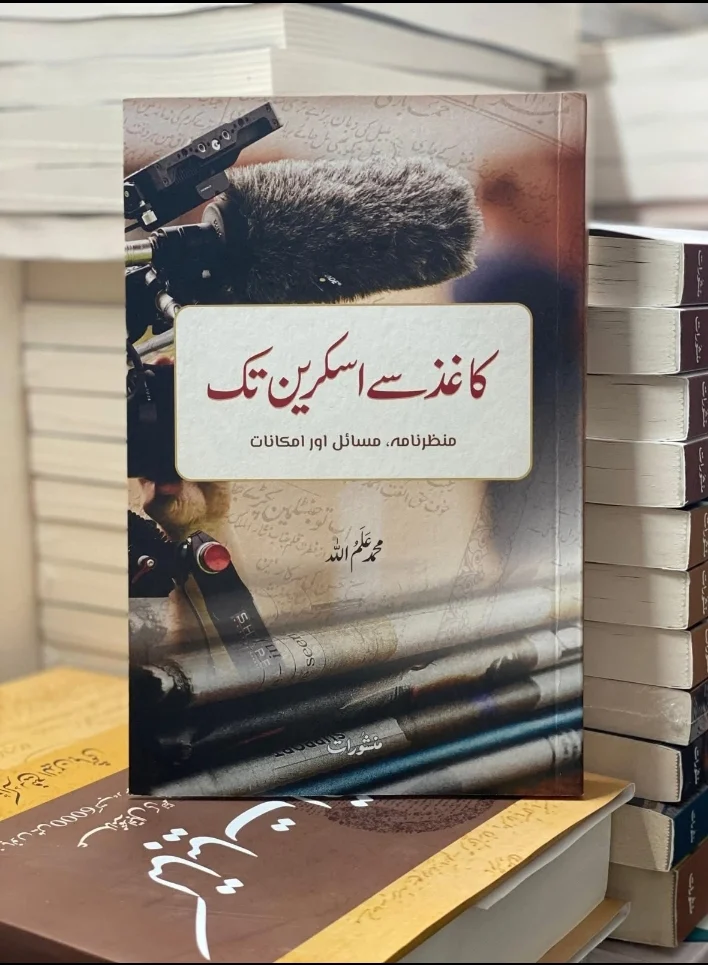
Urdu journalism is often associated with concerns about the declining use of the language, as well as with social, political and cultural questions relating to Muslim society. Even within these areas, emotional responses sometimes receive greater attention than sustained analysis and reflection. As a result, serious writing on subjects such as the arts, sociology, media and social change is often more readily available in English. Alamullah, however, challenges this conventional picture of Urdu journalism. His writing moves with equal ease between questions concerning Urdu, minority representation and social change and subjects such as cinema, theatre, social media, communication and the demands of the modern age. This book is an excellent expression of that breadth and intellectual curiosity. It is not merely a collection of essays; it also provides a valuable record of many of the events, debates and developments of the past decade.
My acquaintance with Mohammad Alamullah dates back almost to the beginning of his journalistic career. We entered Delhi’s Urdu journalism at roughly the same time and, almost simultaneously, made our way into electronic media.
I clearly remember meeting him for the first time in 2007. At that time, Jamia Millia Islamia’s Zakir Husain Library was housed in the old building that now accommodates the Premchand Archives, the NCC and NSS offices, and IGNOU’s Regional Centre. I had only recently entered the university, and its atmosphere seemed to me nothing short of magical. The large buildings spread across the campus and the piles of books in the library never ceased to fascinate me. I would wake up early, get ready and make my way to the campus. Classes began relatively late, but the library opened early, and I could usually be found there in the morning. Sometimes my eagerness was such that I would arrive before the library had even opened and sit on a stone ledge waiting for the doors to open.
One such morning, I entered the newspapers and periodicals section and took a chair at a large table. While reading a newspaper, I noticed that the young man sitting beside me was rapidly writing something in his diary. Perhaps it was indiscreet, but I glanced at what he was writing. My eyes stopped at the title: “The Shadow of Atheism over Jamia Millia Islamia.” My gaze moved from the title to the young man’s face. He was thin, with a bright, expressive face and a smile that conveyed both mischief and confidence. I greeted him and struck up a conversation. As we shook hands, he introduced himself: Mohammad Alamullah. Thus began a friendship that has continued for many years.
Over the years, I have watched Alamullah establish himself in the world of journalism. It is no exaggeration to say that he made his presence felt in Delhi’s Urdu journalism at an early stage of his career. He wrote about the institutional and social character of Jamia Millia Islamia and produced notable reporting during the Batla House encounter. On several occasions, he also demonstrated a willingness to address subjects that few journalists were prepared to present to Urdu readers.
His writings on madrasa reform generated considerable debate on social media. While some readers welcomed his arguments, others strongly opposed them. His views also drew criticism from sections of the religious press, but he remained committed to his position and to the importance of debate. The significance of such exchanges lies not in whether everyone ultimately agrees with a particular argument, but in the fact that subjects often treated as beyond discussion can enter the public sphere and become matters for serious reflection. In that sense, the debate generated by Alamullah’s writing demonstrated the value of questioning established practices and institutions.
When Alamullah came to Delhi, he enrolled in the Department of History at Jamia Millia Islamia. He later realised that journalism was better suited to his temperament and interests and joined the university’s AJK Mass Communication Research Centre. As a graduate of the same institution, I am familiar with its academic environment. It is among the university’s most modern and advanced departments, attracting students from different parts of the country and from a wide range of educational backgrounds. For someone from a rural background who had spent much of his early education in a madrasa, entering such an institution represented a significant transition. Yet Alamullah adapted to this new environment and completed his education while developing an increasingly independent intellectual outlook.
His entry into the institution proved to be an important turning point in his life as a writer. It marked a considerable shift in both his writing style and his areas of interest. He began writing about modern communication, cinema, art, international affairs and geopolitical developments. He also started translating high-quality English-language writing into Urdu. The young man who had once written “The Shadow of Atheism over Jamia Millia Islamia” gradually expanded his intellectual horizons, engaging with subjects far beyond the immediate concerns of his university and early journalistic environment.
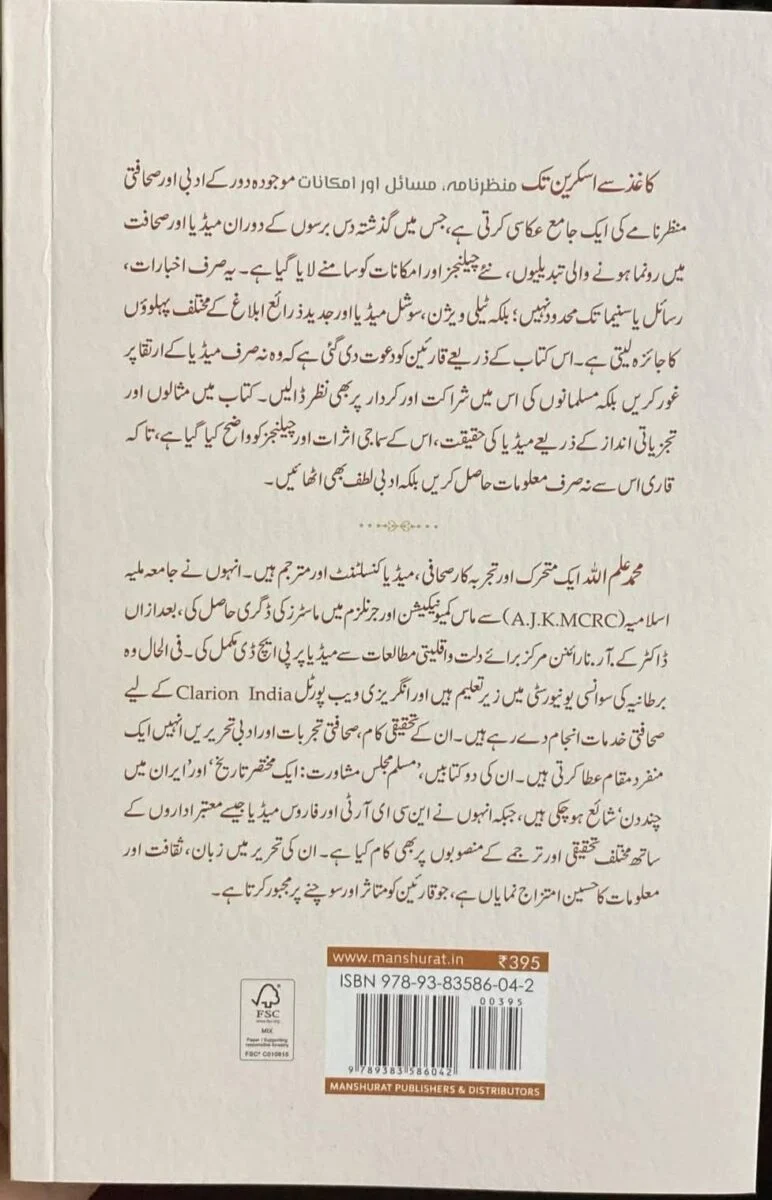
He went on to write two books: Muslim Majlis-e-Mushawarat: Aik Mukhtasar Tarikh (A Brief History of the Muslim Consultative Board) and Iran Mein Kuch Din (A Few Days in Iran), a travelogue that received appreciation from readers and scholars.
Alongside his educational and professional development, Alamullah retained a strong interest in the educational and professional challenges faced by madrasa graduates. He wrote several articles on career planning and on opportunities available to students seeking to move from traditional educational settings into modern academic and professional fields. A number of these writings are included in this book and offer insight into questions that have remained important to the author.
Over the past fifteen years, television news channels have become increasingly influential in India, while televised debates have become a significant part of public discourse. In such programmes, individuals are sometimes presented as representatives of particular religious or social groups. Alamullah has examined the problems that can arise when public representation is reduced to a few predictable voices, particularly when those appearing on television lack the knowledge, preparation or ability to engage with complex issues. His discussion of responsible media representation is included in this book.
Indian media has also developed a remarkable fascination with religious rulings and controversies. Alamullah examined this phenomenon in an article in which he critically discussed a number of controversial fatwas and directly questioned the position of Darul Uloom Deoband on particular issues. The article generated both praise and strong criticism. Whatever one’s view of his conclusions, the essay demonstrates his willingness to enter contentious areas of public debate and to subject influential institutions and established ideas to journalistic scrutiny.
This book is not only a collection of essays on journalism and media. It also considers how modern communication technologies, particularly social media, can be used more effectively. The author chooses subjects that do not always receive sustained attention in Urdu intellectual circles. A glance at many Urdu-language discussions on social media can sometimes create the impression that literary and cultural conversation remains confined to a familiar canon and a limited set of subjects. Against this background, it is refreshing to see a writer discuss filmmaking as a medium of communication, the quality of debate in Urdu journalism, and the need to encourage students from traditional educational backgrounds to explore fields such as journalism, translation and other modern professions.
The essays in this book often carry the perspective of someone who has personally experienced the difficulties of navigating different educational and professional environments. That experience informs his desire to draw attention to the opportunities and obstacles confronting those who follow similar paths.
The final section of the book contains posts originally shared on Facebook. This is an interesting experiment in its own right. These short pieces demonstrate the author’s ability not only to examine an issue at length but also to distil an idea into a few clear and effective paragraphs. In an age when attention spans are increasingly fragmented, that ability is itself a valuable journalistic skill.
Each essay in the book is worth reading. Aspiring journalists, in particular, can learn a great deal from these writings. Reading them often feels like travelling back through the events and debates of the past decade. While some essays resonated strongly with me, I do not entirely agree with the arguments presented in others. Yet disagreement does not diminish the value of a book that encourages readers to think, question and engage. In that respect, this collection offers ample material to both interest and inform its readers.
Another question, however, deserves consideration: would the author have produced a more useful book by writing a systematic and comprehensive study of the subject rather than compiling a collection of essays? In my view, the answer is no. Although these essays might initially appear miscellaneous because they were written over a period of ten years, there is a clear continuity in their themes and concerns. The large number of essays devoted to journalism and media also demonstrates the author’s sustained engagement with the subject.
One of the strengths of the collection is its frequent use of concrete examples. Rather than merely theorising about journalism, the writer observes the media landscape closely and identifies its weaknesses and contradictions. The book draws attention to two broad sets of problems. The first concerns the media itself: weaknesses in language and expression, questions of impartiality, the influence of media ownership, and the continuing erosion of editorial standards. The second concerns the representation of Muslims and other minority communities in the media, including the tendency to reduce complex communities to simplified images and stereotypes, as well as the difficulties that arise when representatives lack an adequate understanding of how the media operates.
Importantly, Alamullah examines the attitudes and shortcomings on both sides. While he criticises the media for approaching minorities with preconceived assumptions, he is equally critical of sections of the communities concerned for failing to understand the importance and potential of the media. He questions the reluctance to engage with forms of communication such as filmmaking and argues for a more informed and confident approach to contemporary media. His writing is direct, sometimes provocative, but ultimately intended to encourage discussion and action.
I hope readers will come away from this book with new ideas and fresh subjects for reflection. For those entering Urdu journalism from traditional educational backgrounds, the book will be particularly useful. More broadly, its themes extend beyond the boundaries of any single community. Questions of media ethics, representation, communication, social change and the relationship between traditional and modern forms of knowledge concern the wider public sphere.
That is perhaps the greatest strength of Alamullah’s journalism. He has moved between different educational, linguistic and professional worlds, absorbing something from each without allowing himself to be confined by any one of them. His writing reflects that journey.
Above all, this is the work of a journalist who has travelled through many worlds, understood their challenges, and used his pen to build connections between them.
(Malik Ashtar, Senior News Editor, Doordarshan, Delhi)