


Anwarul Haq Baig
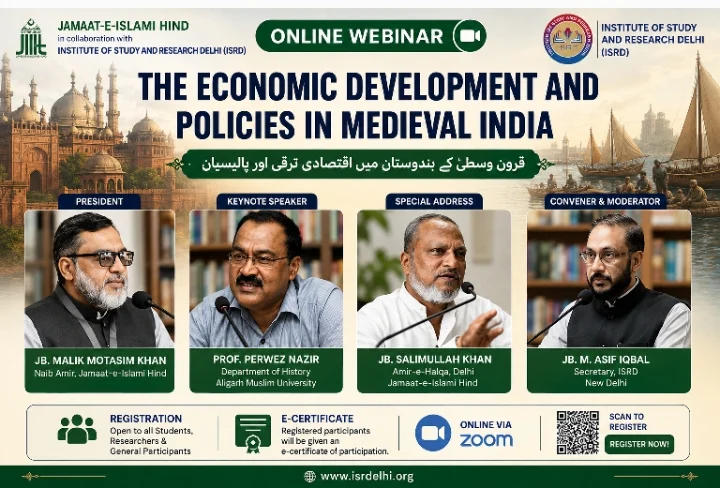
New Delhi: Experts at a webinar titled “Economic Development and Policies in Medieval India” examined various dimensions of the medieval Indian economy, saying that India was one of the world’s major and strongest economies during the period. Organised by the Institute of Study and Research Delhi (ISRD), the webinar covered agriculture, irrigation, textiles, handicrafts, metallurgy, revenue administration, trade and market development.
The webinar was chaired by Jamaat-e-Islami Hind (JIH) Vice President Malik Moatasim Khan while Professor Pervez Nazir of the Department of History, Aligarh Muslim University (AMU) delivered an hour-long lecture on different aspects of the medieval economy and later responded to questions from participants.
Agriculture, Trade and Industry Were 3 Pillars of Medieval India’s Economy: AMU history Professor
In his lecture, Professor Nazir said the subject of economic policies and development in India from the eighth to the eighteenth century was extremely broad. He therefore focused primarily on the Sultanate and Mughal periods, with particular attention to their economic policies and development.
He highlighted several important economic initiatives of the Sultanate period. He described Alauddin Khalji’s rationing system and public-distribution arrangements as significant developments of the period. He explained the distinctive features of Muhammad bin Tughlaq’s establishment of a separate department for agriculture and discussed Firoz Shah Tughlaq’s urbanisation initiatives, explaining how the expansion and development of urban centres contributed to economic growth and greater stability for the state and the people.
He also examined Sher Shah Suri’s land-classification system, revenue policies and taxation arrangements, explaining how these measures helped lay the foundations for economic development in India.
Why India Was Called the “Golden Bird”
Professor Nazir attributed India’s reputation as the “Golden Bird” to the strength of its economy and the economic policies pursued by successive rulers.
He said the Mughal rulers inherited an established economic legacy and further developed and strengthened it.
He cited the widely discussed historical estimate that during the reign of Aurangzeb, India accounted for around 25 per cent of global GDP. Such historical GDP figures, however, are retrospective estimates rather than modern national-account statistics.
Professor Nazir said India had historically been a predominantly agricultural country and that agriculture was also a major source of income during the Mughal period. He identified agriculture, trade and industry as the three broad pillars of the medieval economy.
During the medieval period, governments levied taxes and duties on the movement of goods and commercial activities and used the revenue for state development and public welfare. Rulers also encouraged manufacturing and established workshops, industries and karkhanas to produce goods for ruling elites as well as the wider population.
Medieval chroniclers, he said, recorded details of these industries, including the procurement of raw materials and production processes.
He also discussed sericulture, explaining that silkworms were raised on mulberry trees and that silk production involved organised cultivation and processing under state supervision.
Tipu Sultan’s Economic Initiatives
Professor Nazir described Tipu Sultan as an “enterprising ruler” who drew on earlier Indian experience and sought to develop agriculture, trade and industry along more systematic and scientific lines.
He cited Mysore’s silk industry, noting that Mysore remains renowned for silk textiles. Under Tipu Sultan, he said, sericulture was promoted under state supervision. Farmers were encouraged to cultivate mulberry trees with state support and financial assistance, while large workshops were established for silk production.
Tipu Sultan also developed trade infrastructure. Professor Nazir referred to trading factories and commercial establishments in the Gulf and the Middle East, including Oman, where goods could be stored and preserved for trade and procurement.
He also mentioned systems of quality assurance and price fixing, saying these reflected an organised approach to economic management under Muslim rulers.
Dadabhai Naoroji and the “Drain of Wealth”
Professor Nazir concluded by referring to Dadabhai Naoroji, the Indian nationalist, economist and British parliamentarian, who sought to understand why an India that had been economically and industrially prosperous was becoming increasingly impoverished under British rule.
Naoroji’s historical analysis led him to formulate the “Drain of Wealth” theory, arguing that substantial resources were being transferred out of India under colonial rule.
Agriculture: The Backbone of the Medieval Economy
In his presidential address, JIH Vice President Malik Moatasim Khan said Professor Nazir had highlighted several dimensions of the medieval economy, but the most important, in his view, was agriculture. “The most important thing in the medieval period was agriculture.”
He said India produced such large quantities of grain, cotton, sugarcane and other agricultural commodities that, besides meeting domestic requirements, it was capable of meeting the needs of other regions as well. Agriculture, he said, therefore constituted a major part of the country’s economy.
Muslim rulers, he added, made effective use of canals, rivers, ponds and coastal areas, while irrigation and the better utilisation of water resources played an important role in expanding agricultural production and economic activity.
Textiles, Handicrafts and Industry
Malik Moatasim Khan identified textiles, handicrafts and manufacturing as another major component of the economy. A wide range of goods was produced by hand, including cotton textiles, carpets and metalwork.
He described handicrafts as the “third important aspect” of the economy and also underlined the importance of a sound revenue system, road construction and markets.
“Whether it is the construction of roads or markets, better agricultural practices, irrigation, or developing the revenue system—all these, Islam considers part of the religion.”
He said Muslim rulers of pre-British India had political objectives such as expanding their territories, strengthening their armies and consolidating their power. But, he argued, public welfare and service were also important considerations.
“The foundation behind all this was their inspiration from Islam.”
That inspiration, he said, included “benefiting the people, looking after them, keeping them content, providing them facilities, serving them and ensuring their prosperity.” Whether the population was Hindu or Muslim, he added, rulers undertook works for the welfare of their subjects.
History Should Not Become a Pretext for Revenge
Malik Moatasim Khan said Muslim rulers were often criticised over jizya and allegations of temple destruction, with their entire period sometimes portrayed as an “age of darkness and oppression”.
He said such narratives were being used in contemporary society to generate hatred and hostility towards Muslims and to justify taking revenge on present-day Muslims for the alleged wrongs of rulers of the past.
There may have been “good as well as bad and wrong things” during the period, he acknowledged, but he called it “extremely unreasonable and unscientific” to hold present-day Muslims responsible for the wrongs of rulers of the past.
According to him, India has now undergone enormous development and its economic policies have changed considerably, but the fruits of development have not reached people in proportion to the country’s progress.
He pointed to poverty, unemployment and farmers’ problems as major and growing challenges.
Economic Development Must Be Accompanied by Ethics
Malik Moatasim Khan stressed that the medieval economic order also had a strong moral dimension.
He said wealth creation was necessary, but development without ethics lacked depth and sustainability.
Referring to the Qur’an, he said wealth should not be entrusted to those unable to manage it properly; rather, it should be protected and put to productive use.
Islam, he said, prohibits acquiring wealth through unlawful means such as interest, theft and fraud, while earning wealth lawfully and using it to help the poor, vulnerable, weak and needy is a virtuous act.
He therefore urged Muslims to advance in agriculture and other economic sectors, increase their earnings and contribute more through zakat and charity.
He emphasised the Islamic principle that wealth should be generated and allowed to circulate rather than remain concentrated in the hands of a few.
He called upon Muslims to strengthen their presence in the organised and unorganised sectors, government employment, small-scale industries, large industries and handicrafts.
He also highlighted the historical contribution of Muslims to traditional industries:
“Muslins had the entire brassware business in Moradabad and they had the lock industry in Aligarh, they had the fantastic handicrafts, fabrics, bangle and the leather business.”
Saleemullah Khan: Focus on Those Who Built, Not Those Who Destroyed
Addressing the webinar, JIH Delhi President Saleemullah Khan, stressed the need to focus on the constructive contributions of those who built and developed society rather than giving disproportionate attention to those who caused destruction.
He referred to the writings of the renowned scholar Syed Sulaiman Nadwi, saying they contain valuable references concerning the role of Muslim rulers in the intellectual development of their non-Muslim subjects. Muslims, he said, had played an important role in shaping India, and that contribution needed to be brought into public discussion.
Agriculture and Employment Today
Khan said agriculture continues to provide employment to roughly 46 per cent of India’s workforce, while its contribution to national GVA (Gross Value Added) is around 18 per cent.
He said the disparity deserved serious reflection, “If a sector provides employment to nearly half the people but contributes only around 18 per cent to GDP, that itself is something we need to think about very seriously.”
He also expressed concern over growing economic inequality and referred to economist Raghuram Rajan, saying that figures such as Rajan had pointed to the growth of crony capitalism in India.
ISRD Secretary and convenor of the webinar, Asif Iqbal, stated that studying India’s economic history from the eighth to the eighteenth century helps in understanding its agricultural systems, trading networks, handicrafts, and financial policies. He highlighted revenue administration under the Delhi Sultanate and Mughal Empire, royal patronage, and expanding trade as important factors in economic development.
The webinar was attended by students, scholars of history and economics, and others interested in the subject.