
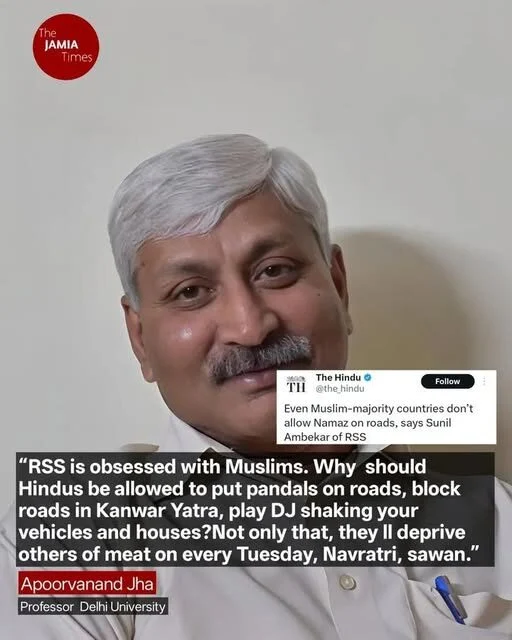


Prof. Apoorvanand recently slammed the RSS–Hindutva groups and exposed what he described as a glaring double standard in how public religious practices are treated in India.
In a post on X, he questioned why Hindu religious activities. He asks “if pandals can occupy roads, if the Kanwar Yatra can halt traffic, if loudspeakers blare without restraint—why does namaz in an open space suddenly become a “problem”? Why is one community’s visibility treated as tradition, and another’s as disruption?
He also points out that restrictions on meat during certain Hindu festivals don’t just reflect belief, they quietly dictate what others can or cannot eat.
Responding to RSS leader Sunil Ambekar’s claim that even Muslim-majority countries don’t allow prayers on roads, Apoorvanand flips the frame, the real issue isn’t rules, it’s who those rules are applied to.
It shows that public space in India isn’t neutral. It can only be used for the majority religious rituals and processions bluntly, but cannot be even used in cases of emergency or urgency but Muslims.
Apoorvanand’s remarks trigger many questions in our minds over the double standard policy…If equality is the standard, why are meat bans enforced during majority community festivals. Because non-veg is not permitted or is disliked in their tradition?
Why should the dietary rules of one community spill over into public restrictions affecting everyone else?
If non-veg food is a normal—and at times religiously significant—part of life for Muslims, especially during Eid al-Adha (very much linked to Prophet Ibrahim), on what basis is it restricted for them as well?
If pluralism is the principle, why are majority sentiments treated as public norms while minorities are expected to conform?
By the same logic, Abrahamic faiths—especially Islam and Judaism—strictly prohibit idol worship. Applying their sentiments similarly, if they give a call for a ban on idol worship in public during their religious festivals, will you accept?
If one community’s religious preferences cannot justifiably restrict others, why should they do so in matters of food?
Why should people from other communities be expected—or pressured—to follow vegetarian practices for someone else’s faith during its festivals?
Food is a personal choice, as long as it does not violate humanity or fundamental human rights.