
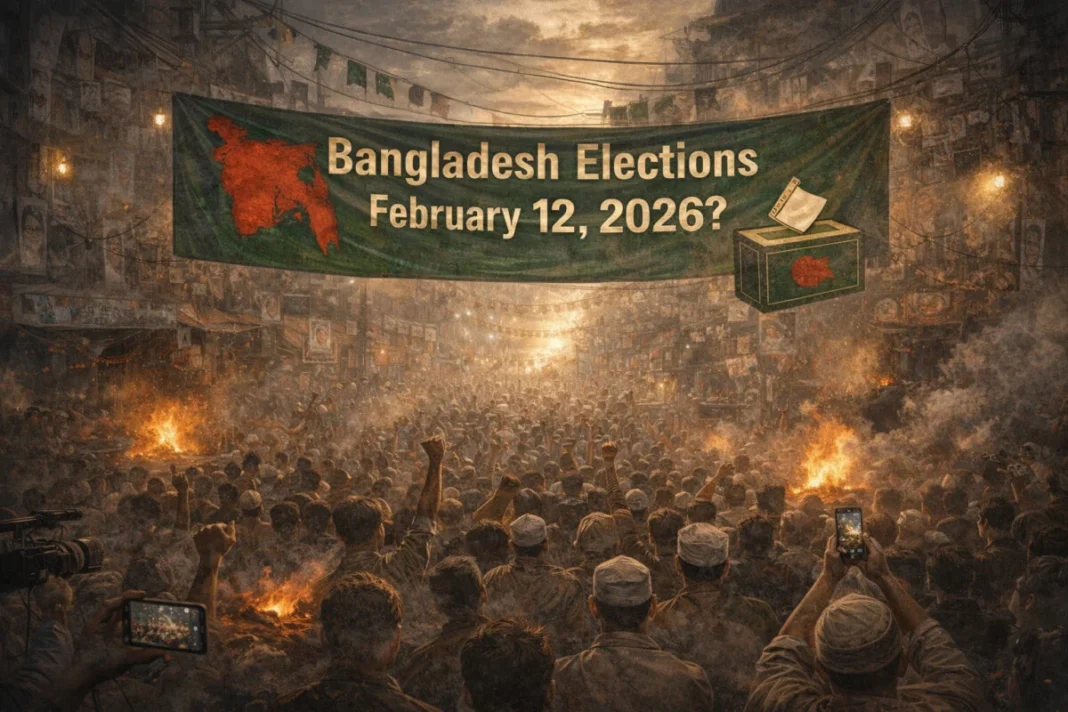


Bangladesh, a country of more than 175 million people, the vast majority of them Muslim, heads to the polls on February 12, 2026, in its first general election since the 2024 student-led uprising that ended Sheikh Hasina’s 15-year controversial rule.
Voters will elect 300 members of parliament to the Jatiya Sangsad through first-past-the-post voting, alongside 50 reserved seats for women allocated proportionally. With over 127 million eligible voters, the exercise ranks among the largest democratic elections globally in 2026 and coincides with a constitutional referendum on the July Charter reform blueprint.
The Awami League has been barred from contesting after crimes-against-humanity charges linked to the 2024 unrest, in which the United Nations estimates around 1,400 people were killed. Hasina, sentenced to death in absentia in November 2025, fled to India in August 2024.
From exile in New Delhi on January 23, Hasina warned that “Bangladesh stands today at the edge of an abyss, a nation battered and bleeding,” adding that “democracy is now in exile.” She accused the interim administration of engineering the vote, saying, “Bangladesh will never experience free and fair elections until the shadow that Yunus casts is lifted.” She also called for a UN investigation and urged citizens to “rise up unitedly to restore the constitution and protect religious minorities.”
Dhaka’s foreign ministry condemned India on January 25 for hosting the address, calling it “a clear affront” that “may jeopardise bilateral ties.”
Interim Rule and a Democratic Reset
The interim government, led since August 2024 by Nobel Peace Prize laureate Muhammad Yunus, has pledged a credible vote. Yunus described the election as “a democratic reset” that would “set the standard for good elections.” He is expected to step down after polling.
Jamaat’s Return in Electoral politics
Once banned for more than a decade under Hasina, Bangladesh Jamaat-e-Islami (BJI) has staged a striking political comeback. The Supreme Court invalidated Jamaat’s registration in 2013, and a full ban followed on August 1, 2024, after the party backed quota-reform protests. The ban was lifted on August 28, 2024, and Jamaat’s registration was formally restored on June 1, 2025.
Ahead of the election, Jamaat aligned with the Like-minded 11 Parties, pressing for proportional representation and a pre-election referendum on the July Charter. It finalised seat-sharing arrangements with the Liberal Democratic Party and the National Citizen Party (NCP) on December 28, 2025. Party officials say around 80 percent of its candidates are first-time contestants, reflecting an effort to foreground younger leadership.
Jamaat Ameer Dr. Shafiqur Rahman has framed the party’s pitch around stability and clean governance. “We want to see a stable nation for at least five years. If the parties come together, we’ll run the government together,” he said.
On leadership, he added:“The prime minister will come from the party that wins the most seats.”
Anti-corruption, he argued, is non-negotiable: “Without eliminating corruption, no government—unity or otherwise—can survive or serve the people.”
Countering Theocracy Fears, Policy-Centric Campaign
At a recent rally in Rangpur, Rahman sought to allay domestic and international concerns over Islamist rule.“If Jamaat comes to power, Bangladesh will remain Bangladesh. It will not turn into Pakistan, Afghanistan, or Iran,” he said.
Invoking the Charter of Madinah as an ethical model, he promised:“Justice and the rule of law will be established, and people of all religions and backgrounds will enjoy equal rights.”
Rahman also launched a personal attack on Hasina, saying:“She is not the ‘mother of humanity’; she is the ‘mother of cruelty.’”
Party spokesperson Mohammad Rahman told bdnews24.com that Jamaat’s platform rests on “anti-corruption, transparency, accountability and good governance,” adding that proposals on women’s working hours remain preliminary and that “Jamaat has no plan to implement Sharia law.”
At its January 20 “Policy Summit 2026”, Jamaat unveiled an expansive agenda: gradual tax and VAT reductions (to 19 percent and 10 percent respectively), a Smart Social Security Card, a freeze on industrial utility tariffs, worker ownership stakes in revived factories, interest-free loans for farmers, and a Qarz-e-Hasana scheme offering monthly support to 500,000 graduates.
Additional pledges include education loans, overseas scholarships for low-income students, the creation of a mega women’s university through institutional mergers, free healthcare for citizens over 60 and children under five, 64 district hospitals, and a “First Thousand Days” maternal and child health programme.
Diplomatic Openings and Youth Momentum
Jamaat’s re-emergence has drawn close international scrutiny. In December 2025, a closed-door discussion by a US diplomat in Dhaka—audio of which was later cited by The Washington Post—described Bangladesh as “shifted Islamic” and predicted Jamaat would “do better than it’s ever done before.”
The diplomat said, “We want them to be our friends,” dismissed fears of religious imposition—“I simply do not believe that Jamaat can impose sharia”—and warned that any troubling moves would prompt swift retaliation: “We would have 100 percent tariffs put on them the next day.” The US Embassy later described the meeting as routine.
Rahman told Reuters in January that he had also met an Indian diplomat in 2025:“We have to be open to everyone. There is no alternative to improving mutual relations.”
India’s external affairs ministry characterised such contacts as standard diplomatic engagement.
Jamaat’s organisational depth has been reinforced by youth mobilisation. The landslide victory of Islami Chhatra Shibir, Jamaat’s student wing, in Dhaka University Central Students’ Union (DUCSU) elections in September 2025 highlighted its campus influence.
Legacy of the ICT and Political Memory
Jamaat’s return comes after a domestically set up, the controversial International Crimes Tribunal (ICT) trials of 2013–2016, which prosecuted alleged crimes committed during the 1971 war. The tribunal faced sharp criticism from Human Rights Watch, Amnesty International, and UN experts over due process failures, judicial bias, and failure to meet international fair trial standards. The first major indictments included nine senior BJI leaders Ghulam Azam (former chief, 1971 East Pakistan unit leader), Matiur Rahman Nizami ( incumbent party chief), Delwar Hossain Sayeedi (incumbent deputy chief), Ali Ahsan Mohammad Mojahid (secretary general), Muhammad Kamaruzzaman (assistant secretary general), Abdul Quader Molla (assistant secretary general), Mir Kashem Ali (media head, pro-Jamaat Diganta Media Corporation), and Miah Golam Parwar, Abul Kalam Azad (former associated Islamic cleric).
Five were executed between 2013 and 2016: Abdul Quader Mollah, Muhammad Kamaruzzaman, Ali Ahsan Mohammad Mojaheed, Motiur Rahman Nizami and Mir Quasem Ali. Whereas, Delwar Hossain Sayeedi later died in custody in 2023 after his death sentence was commuted, while former party chief Ghulam Azam died in 2014 while serving a 90-year sentence.
BNP: Campaign Amid Internal Turmoil
The Bangladesh Nationalist Party (BNP) began campaigning on January 22, 2026, with a rally in Sylhet led by Tarique Rahman, who returned from 17 years in UK exile on December 25, 2025, days before the death of his mother, former prime minister Khaleda Zia, on December 30.
BNP Secretary General Mirza Fakhrul Islam Alamgir has endorsed Tarique as the party’s prime ministerial candidate. The BNP formally ended its alliance with Jamaat in August 2025, seeking to reclaim secular nationalist credentials.
Candidate selection, however, proved destabilising. The first list, covering 237 seats on November 3, triggered protests in more than 40 constituencies. A second list alienated allies, prompting the Bangladesh Labour Party to end an 18-year partnership, while the LDP and JSD (Rab) chose to contest independently. Despite warnings, 92 rebel candidates entered races across 79 seats, leading to mass expulsions reported by Prothom Alo and bdnews24.com.
The BNP manifesto—drawing on Ziaur Rahman’s 19-point programme, Khaleda Zia’s Vision 2030, and Tarique Rahman’s proposals—emphasises democratic restoration, judicial independence, decentralisation, anti-corruption enforcement, job creation, education reform and minority protections.
New Players, Referendum and Security Risks
The National Citizen Party continues to campaign for a constituent assembly and a new constitution, recruiting heavily from outside its membership base. Its electoral alliance with Jamaat, despite internal dissent, has reshaped opposition arithmetic.
The Jatiya Party remains fractured, while left-wing groups have coalesced into a Democratic United Front with limited but vocal influence.
A referendum on the July Charter will be held alongside the election. The European Union has deployed 200 election observers, while the UN declined to participate.
Concerns over violence intensified after Sharif Osman Hadi (33)—Inqilab Moncho convenor and an independent candidate in Dhaka-8—was shot on December 12, 2025, and died six days later in Singapore. His killing sparked widespread protests and vandalism and security concerns for minorities.
The February 12 election will determine whether post-uprising Bangladesh turns to established opposition forces like BNP, embraces reformist newcomers, or hands power to Jamaat’s vision of tightly controlled, corruption-free governance.