
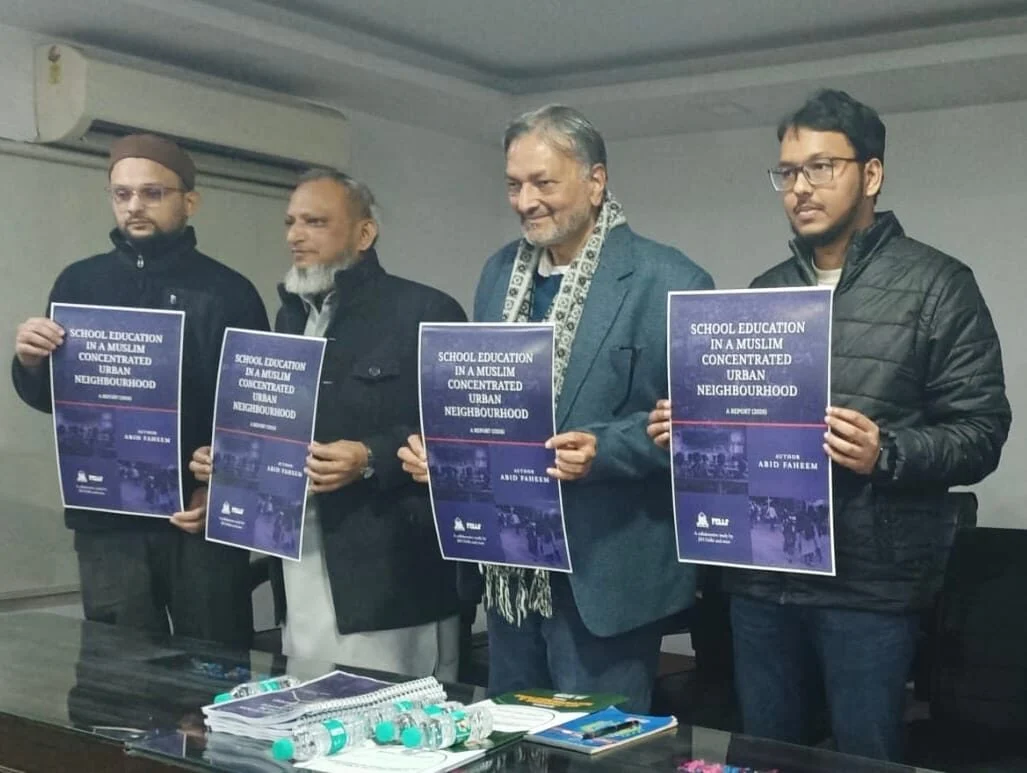


New Delhi: A first-of-its-kind ground-level study by Jamaat-e-Islami Hind (JIH) Delhi and the NOUS Network has exposed severe educational and socio-economic deprivation in Jamia Nagar, Delhi’s largest Muslim-dominated neighbourhood.
Titled “School Education in a Muslim-Concentrated Urban Neighbourhood: A Case Study of Jamia Nagar, South-East Delhi”, the report was jointly released at the JIH headquarters in Delhi recently in the presence of academics, educationists, civil society members, and community leaders.
The study reveals that Shaheen Bagh has no government school, forcing residents to depend on limited or costly alternatives. About 67% of households survive on less than ₹10,000 per month, with only a small fraction earning above ₹20,000. Over half of parents rely on informal livelihoods such as daily wage labour, petty trade, or low-paid services.
Educational deprivation within households is severe. Nearly 48% of fathers and over 70% of mothers have not studied beyond the primary level, limiting academic support for children. Compounding this, over 60% of families have five or more members, intensifying economic pressure.
Housing and basic amenities remain inadequate. Around 47% of families live in semi-pucca houses and 17% in kutcha structures, with more than half cramped into one or two rooms. 32% lack private toilets, 28% depend on shared sanitation, 21% have no regular access to clean water, and 25% face irregular electricity, directly affecting children’s ability to study.
Despite these hardships, early enrolment stands high at 94% with minimal gender gap. Aspirations remain strong, with over 97% of children expressing a desire for higher education and 41% aiming for professional careers. However, 52% identify financial constraints as the biggest barrier. Dropout rates rise sharply after Class 8, with nearly 34% discontinuing education before completing secondary school.
Schooling patterns show systemic strain. While a majority attend government schools where available, limited public options have pushed many families toward private schooling. Teacher shortages affect 29% of schools, 37% of students report inadequate infrastructure, and 44% lack access to personal smartphones or computers. Migration disrupts education for 38% of families, with nearly 45% of affected children experiencing learning disruption or dropout. Alarmingly, 31% report discrimination based on religion, caste, language, or economic background, impacting participation and confidence.
Learning outcomes in Urdu, English, and Mathematics lag behind national ASER benchmarks, even in higher grades, despite a growing preference for English-medium instruction. The report concludes that the absence of government secondary and senior secondary schools, particularly in Shaheen Bagh, is widening inequality and undermining educational aspirations.
Releasing the report, JIH Delhi State President Salimullah Khan said the study emerged from a decision taken by the JIH Delhi advisory council in April 2023 to move beyond assumptions and fragmented information. He said, “Most discussions were based on assumptions or fragmented information. A formal, scientific study was necessary to guide policymakers, NGOs, educational institutions and even government bodies.” He highlighted that despite Jamia Nagar’s dense population and proximity to educational institutions, there was no data-driven understanding of its educational realities. The survey, led by Ali Javed of NOUS, began on March 1, 2024, and was completed over a period spanning approximately two years.
Khan emphasized education’s role in social mobility, drawing comparisons to global examples like China’s investments in education and innovation for productivity and advancement. “The report should be seen as a starting point,” he added, stressing that its value depends on stakeholders translating findings into concrete action.
Presiding over the programme , Dr. Aejaz Masih, from the Department of Education at Jamia Millia Islamia underscored the need to view education in the context of living conditions. He noted the stark contrasts in Jamia Nagar, where premier institutions coexist with households lacking basic amenities. “No country can progress by leaving any community behind,” Dr. Masih said. He praised the report’s transparency about its limitations and recommended follow-up institutional surveys to connect learning outcomes with teacher profiles, school environments, and institutional characteristics. He also pointed out the need for deeper analysis of teachers themselves when calling for training.
Dr. Abid Faheem, the lead author who oversaw research design, fieldwork, data analysis, and report writing, presented the key findings and recommendations. Ali Javed, founder of NOUS, reiterated the importance of evidence-based studies for targeted interventions and long-term policy responses.
The report urges targeted scholarships, migrant-friendly welfare, strengthened government schools, improved digital access, hostels, anti-discrimination measures, remedial programs, mentoring, and evidence-based policy reforms for government, NGOs, and community groups.
The study is based on a large-scale household-level survey covering 2,700 households and 3,872 children aged 3–18 across 12 localities in Jamia Nagar. It combines school mapping with basic learning assessments and disaggregated analysis by gender, caste, wealth, and migration background, addressing gaps in national datasets that overlook neighbourhood-level realities.
The report stresses that educational disadvantages in Jamia Nagar stem not from lack of aspiration, but from institutional bottlenecks, uneven public provisioning, financial burdens, and systemic barriers. It calls for targeted scholarships, migrant-friendly welfare measures, expansion of government schools, improved digital access, hostels, anti-discrimination safeguards, and evidence-based policy reforms.
Overall, the study highlights deep structural inequalities alongside remarkable resilience and ambition among Jamia Nagar’s students, urging urgent and inclusive educational interventions to bridge the widening gap.
The full report can be downloaded from the following link:
https://www.nousnetwork.org/content/files/2026/01/Education_Report_Jan_2026.pdf