


By: Anwarulhaq Baig
New Delhi: A pioneering large-scale household survey by Jamaat-e-Islami Hind (JIH) Delhi and the NOUS Network has brought to light the profound socio-economic and educational hurdles facing Jamia Nagar, Delhi’s largest Muslim-concentrated urban neighbourhood in South-East Delhi. The comprehensive 103-page report, titled School Education in a Muslim-Concentrated Urban Neighbourhood: A Case Study of Jamia Nagar, South-East Delhi (2026), authored by Dr. Abid Faheem, is grounded in primary data from 2,700 households (with 2,648 Muslim households analysed after excluding 52 non-Muslim ones) and 3,872 children aged above 3 years up to 18 years across 12 localities.
The study integrates detailed mapping of 125 educational institutions, basic learning assessments in Urdu, English, and Mathematics, and careful disaggregation by gender, caste, wealth, and migration background. Released at JIH headquarters in the presence of academics, educationists, civil society members, and community leaders, the report firmly asserts that educational disadvantages in Jamia Nagar arise not from any lack of ambition or cultural factors, but from institutional shortcomings, grossly uneven public school availability, heavy financial pressures, and entrenched systemic neglect.
Survey Coverage and Localities: Uneven Ground Zero
The survey encompassed 12 localities in Jamia Nagar: Abul Fazal Enclave, Batla House, Ghaffar Manzil, Haji Colony, Jogabai, Johri Farm, Noor Nagar, Okhla Vihar, Shaheen Bagh, Tayyab Colony, Zakir Nagar, and Zakir Nagar Extension. School-going children distribution — a reliable proxy for population density — reveals marked concentration: Batla House represented approximately 20.7 percent of surveyed children, Abul Fazal Enclave 20.3 percent, Zakir Nagar 17.4 percent, Shaheen Bagh 17.0 percent, Okhla Vihar 8.5 percent, and Johri Farm 4.9 percent, with the remaining localities sharing the rest. Educational institutions mirror this imbalance, with 84.8 percent of the 125 mapped schools clustered in just five areas: Abul Fazal Enclave (24.8 percent), Shaheen Bagh (18.4 percent), Batla House (16.0 percent), Jogabai (12.0 percent), and Zakir Nagar (13.6 percent).
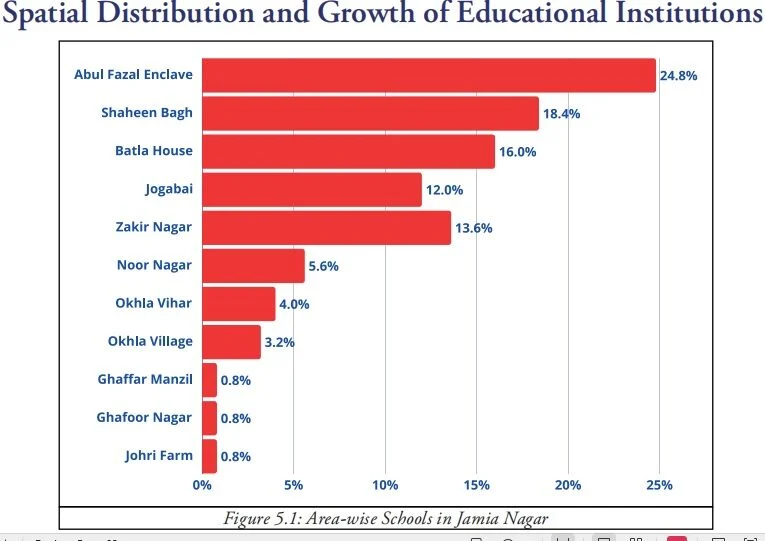
Even Shaheen Bagh — globally known for its historic women-led sit-in against the controversial CAA/NRC — has no government school, leaving residents reliant on limited or costly alternatives. This stark spatial inequality strands entire pockets, compelling families to endure long commutes or turn to expensive private options, underscoring how access remains geographically constrained.

Household and Demographic Profile: Migration Trap and Civic Exclusion
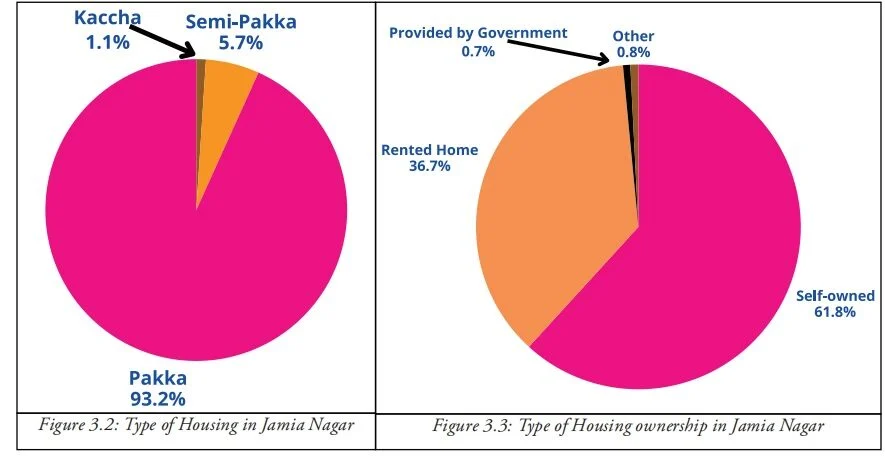
The report portrays a predominantly nuclear family setup, with nuclear families comprising 80.6 percent of households and joint families a mere 2.8 percent. Ownership stands at 61.8 percent in owned dwellings, 36.7 percent in rented accommodation, and minor shares in government quarters (0.7 percent) or employer-provided housing (0.8 percent), reflecting ongoing challenges in affordability and stability, especially for migrants. Male-headed households dominate at 87.2 percent (mostly fathers), while female-headed account for 12.8 percent.
Migrant households form 51.7 percent of the sample — 56.5 percent from Uttar Pradesh and 32.5 percent from Bihar — and 21.9 percent of respondents lack a Delhi voter ID, with 44.6 percent of them having lived in the city for 5–10 years, highlighting incomplete civic integration despite prolonged residence. This migration reality heightens vulnerabilities, as migrant households drive 61.6 percent of dropouts while representing roughly half the population — a poignant reminder of how mobility disrupts educational paths.
Housing Conditions and Basic Amenities: Persistent Material Gaps
Housing quality shows progress, with 93.2 percent of households in pakka (permanent, durable-material) structures, 5.7 percent in semi-pakka, and 1.1 percent in kaccha homes. Yet significant gaps persist: 14 percent lack a separate kitchen, 6.7 percent have no in-house toilet, 16.9 percent lack a fridge, 12.2 percent no gas cylinder for cooking, 10.5 percent no smartphone, 61.8 percent no laptop or computer, 47.4 percent no Wi-Fi, 50.1 percent no geyser, 61.4 percent no two-wheeler, and 82.3 percent no four-wheeler. Only 14.3 percent read a newspaper regularly. These limitations severely restrict conducive study spaces and digital access, deepening inequality in a locality near premier institutions.
Parental Education, Occupation, and Income: Generational Challenges Persist
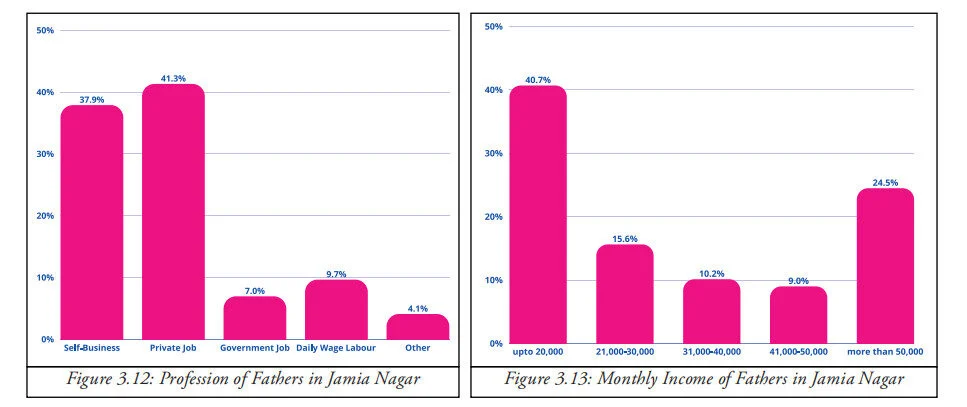
Parental schooling remains limited for many, with 27.8 percent of fathers and 27.1 percent of mothers having no formal education, and madrasa education rare (1.3 percent fathers, 2.4 percent mothers). English-medium exposure was reported for 59.5 percent of fathers and 52.5 percent of mothers, but this has not bridged generational gaps. Fathers’ occupations include 41.3 percent in the private sector, 37.9 percent self-employed, and only 7.0 percent in government jobs; 41.7 percent earn ₹20,000 or less per month, while 24.0 percent exceed ₹50,000. Mothers are 90.6 percent homemakers; among working mothers, 48.4 percent private sector, 19.1 percent self-employed, with 34.2 percent earning up to ₹10,000/month and 18.3 percent above ₹50,000 — high dispersion limits home support. Caste shows 56.3 percent General and 37.1 percent OBC households, with wealth disparity clear: 47.0 percent General rich vs. 33.4 percent OBC, illustrating how social and economic factors converge to influence access.

Enrolment, Dropout, and Aspirations: Dreams vs. Harsh Realities
Enrolment is robust at 94.0 percent among 3,872 children (50.6 percent boys, 49.4 percent girls), with 3.7 percent never enrolled (mostly early childhood) and 2.3 percent dropped out (concentrated at ages 17–18). Boys comprise 58.1 percent of dropouts, poverty leads reasons, followed by academic difficulty and low interest, with structural issues overlapping. Primary-level enrolment is 52.6 percent, aligning with younger demographics. Aspirations soar: 97.4 percent seek higher education across all groups, showcasing deep community commitment. Private coaching reaches 20.8 percent (79.1 percent for school aid, 16.5 percent for exams), surges with wealth, and shows minimal gender gaps — highlighting how paid extras amplify divides.
School Type, Medium, and Access: Private Dominance
As many as 56.7 percent attend private schools, 40.2 percent government, 84.3 percent English-medium. Wealth/caste patterns are sharp: 61.5 percent poorest in government vs. 78.6 percent richest in private; 63.8 percent General private vs. 45.9 percent OBC. Gender differences negligible. Distance: 66.8 percent <2 km, 12.9 percent >5 km (often wealthier families) — exposing how the less privileged face poorer local options.
Institutional Mapping and Gaps: Private Surge, Public Shortfall
Mapping shows private-led growth: 58.4 percent institutions post-2013, 65.6 percent privately managed, 52.8 percent primary-only, only 17.6 percent senior secondary, 63.6 percent of Class 12 privately run. Shaheen Bagh lacks any government school despite density.
Learning Outcomes: Foundational Shortfalls Persist
Outcomes trail national ASER benchmarks. Urdu: 3.6 percent Class 3 story-level, 49.1 percent Class 8. English: 0 percent Class 3 sentence, 50.5 percent Class 5, 52.7 percent Class 8 (below national 67.5 percent). Maths division: 19.0 percent Class 3, 45.5 percent Class 5, 30.9 percent Class 8 — revealing stagnation/decline. English-medium has not lifted core skills, pointing to deeper quality issues.
Access to Scholarships and Financial Support: Widespread Gap
Scholarships are scarce: only 2.5 percent of children receive aid, 97.5 percent none — despite major Muslim organisations and NGOs nearby. Among recipients, schools provide 50.8 percent, government schemes 22 percent, informal/community 18.6 percent, NGOs 8.5 percent — underscoring reliance on patchy, non-systematic support.
Key Recommendations: A Path Forward
The report affirms Jamia Nagar’s students show extraordinary resilience and ambition, yet confront formidable systemic barriers requiring urgent action. It urges expanding government secondary/senior secondary schools in underserved spots like Shaheen Bagh, targeted scholarships, migrant-friendly welfare, enhanced digital access, hostels, anti-discrimination safeguards, remedial programs, mentoring, teacher training, career guidance, and community accountability networks. The findings advocate longitudinal studies and evidence-driven policies to close gaps and safeguard potential in this vibrant yet challenged neighbourhood.