


By Anwarulhaq Baig
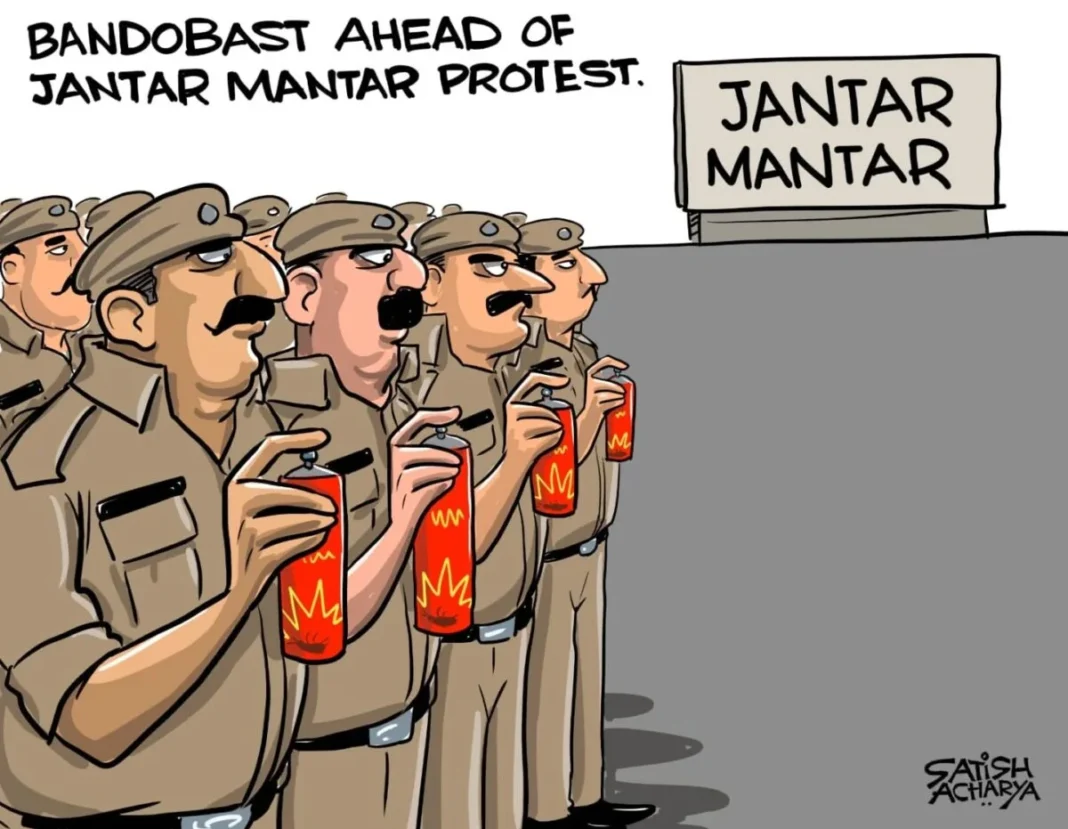
Governments, especially BJP-led administrations, have long used a familiar playbook to contain street protests: barricades, police cordons, restricted movement and site access, internet shutdowns, transport closures, and, when necessary, force.This formula was designed for conventional protests—those occupying physical space, gathering around a stage, raising slogans, carrying banners, and relying on a visible, centralized leadership. However, the Jantar Mantar agitation of 2026 exposed a vulnerability in that playbook. Gen Z defied conventional protest rules. Its true significance lies not merely in a minister’s resignation, but in the novel methods of resistance Gen Z forged. It is the story of smartphones, memes, Instagram Reels, satire, protest songs, AI-generated content, Bluetooth technology, and gig-economy food-delivery networks. Above all, it is the story of a generation that transformed state suppression into new avenues for viral dissent. While the government attempted to control a physical place, Gen Z built a movement in the digital sphere without a fixed location, rendering old containment tactics obsolete.
The Story Did Not Start from Jantar Mantar
The protest story that at the Jantar Mantar didn’t suddenly erupt in 2026. Years of accumulated unease, despair, and anxiety lay beneath the surface. Roots stretched back to political and social developments that deeply impacted the younger generation.
On November 9, 2019, the Supreme Court’s judgment in the Babri Masjid Ayodhya title case paved the way for a Ram temple at the Masjid site. For Muslims and some youth, the ruling created resentment. Within weeks, student protests against the Citizenship Amendment Act (CAA) and the proposed National Register of Citizens (NRC) erupted at Jamia Millia Islamia, Aligarh Muslim University, and nationwide campuses. At Jamia Millia, police action and violence intensified discontent, sparking the historic Shaheen Bagh sit-in in a South Delhi Muslim neighbourhood. Shaheen Baghs spread nationwide, symbolizing a new protest method and trend. Shaheen Bagh showed a protest site could be more than a gathering. It became a community, classroom, stage, kitchen, library, cultural space, and a living expression of dissent. Women sat through cold nights. The physical occupation of a road became a political message travelling far beyond it.
The farmers’ movement, India’s longest protest, saw agriculturalists surround Delhi’s borders against three controversial farm laws. It persisted through the COVID-19 pandemic until the Modi government repealed the laws in November 2021.
From these struggles, the younger generation learned protest wasn’t just slogans, but required pressure, occupation, resilience, community support, technology, and forcing retreat. Shaheen Bagh showed endurance, the farmers’ movement sustained occupation, and Jantar Mantar highlighted the digital network’s power.
Simultaneously, rising unemployment, inflation, youth anxiety, mismanagement of competitive examinations, and recurring paper leaks created a smoldering layer of lava.
The tipping point came when the Chief Justice of India referred to young unemployed people as “cockroaches” during a court proceeding. Boston University student Abhijeet Dipke then posed a viral question: “What if all the cockroaches come together?”
From that satirical idea emerged the Cockroach Janata Party (CJP). An intended insult became an identity, transforming humiliation into resistance, a badge of honor, and a new political vocabulary.
‘Cockroaches’
On June 6, 2026, Abhijeet Dipke returned to India from abroad, and the CJP’s ground mobilization at Jantar Mantar rapidly gained momentum. Demands centered on the resignation of Union Education Minister Dharmendra Pradhan and examination system reforms. The agitation quickly expanded to encompass unemployment, systemic accountability, and the future of India’s youth.
At Jantar Mantar, Gen Z and Gen Y (Millennials) merged digital fluency with protest experience inherited from earlier generations. On June 28, educator and environmental activist Sonam Wangchuk initiated a high-profile 21-day hunger strike at Jantar Mantar, significantly boosting the youth-led movement.
Within weeks, the CJP, known for its satirical approach, amassed over 24 million online followers, vastly outpacing the ruling Bharatiya Janata Party (BJP)’s digital operations.
The Smartphone Becomes the New Protest Headquarters
Traditional movements relied on speeches, pamphlets, political parties, mass meetings, and rigid hierarchies. Gen Z radically shifted this, making the smartphone the ultimate protest headquarters.
Instagram Reels became mobilization tools, memes served as political slogans, satire functioned as a weapon of resistance, and humor acted as a shield against fear. Protesters no longer needed a physical stage to influence thousands; a thirty-second Reel could traverse the country before police barricades could be erected. Thousands gathered physically, but the movement simultaneously existed across millions of screens.
On July 20, 2026, during the “Chalo Sansad” (Let’s March to Parliament) march, the government enforced multi-day, 1.5-kilometer-radius mobile internet shutdowns, closed 16 key Delhi Metro stations, and deployed heavy physical force under Home Minister Amit Shah and the Delhi Police. Gen Z responded by turning the state’s tactics against itself.
With cell towers dark, demonstrators bypassed traditional internet using Bluetooth technology. Protesters deployed BitChat, a decentralized, peer-to-peer Bluetooth Low Energy (BLE) mesh app co-developed by Twitter founder Jack Dorsey. Operating without SIM cards, email registrations, or centralized servers, encrypted data packets hopped between devices across dense crowds, transmitting messages across Jantar Mantar. Recognizing the threat to state surveillance, the Indian Cybercrime Coordination Centre (I4C) ordered GitHub to take down the BitChat repository, but young protesters quickly found alternatives.
Physical police aggression was instantly reframed by Gen Z subculture. Activists recorded “Get Ready With Me” (GRWM)-style reels inside police detention buses and published self-deprecating memes about arrests, stripping physical deterrents of their fear factor.
Digital rights advocate Apar Gupta of the Internet Freedom Foundation (IFF) noted protesters documented unnotified facial recognition, drones, and AI surveillance, sharing footage on Instagram to generate massive public outrage and draw middle-class sympathizers into the streets.
Jantar Mantar became an organized community hub, sustaining the physical occupation. When police cleared tents and stages, protesters regrouped, providing blankets, establishing multi-state volunteer first-aid stations, and arranging free water and food distribution. Supplies flowed seamlessly via online delivery networks like Swiggy and Zomato, funded by supporters in Hyderabad, Mumbai, and Ghaziabad.
Junaid detained for serving students?
Amidst this digital mobilization, Muhammad Junaid, a local volunteer from Ghaziabad, emerged as a prominent humanitarian figure, providing free food and water to protesting students. Junaid’s solidarity came at a heavy personal price. Media reports state Junaid was detained, blindfolded, and interrogated regarding food supply funding, while his family in Ghaziabad faced intense official scrutiny. The stark contrast between a minister’s political resignation and the targeted state harassment of a Muslim volunteer distributing food raised profound questions about citizenship and solidarity.
Simultaneously, ruling-party figures attempted to marginalize the protesters through communal tropes. Former BJP MP Ramesh Bidhuri dismissed Jantar Mantar participants as children of “puncture-repairers” and “locksmiths.” This echoed Prime Minister Modi’s anti-Muslim remarks from a 2025 election rally in Hisar, Haryana. Right-wing voices hurled labels such as “Babur ki aulad,” “jihadi,” “Pakistani,” and “Bangladeshi.” Actor Kangana Ranaut, for instance, dismissed Gen Z as the “gutter generation.” Furthermore, right-wing ideologue T.G. Mohandas from Kerala made the egregious remark that “Jantar Mantar girls love being raped.”
The abuse sparked intense anger among Gen Z, Gen Alpha, and citizens nationwide. Some RSS officials branded youth as anti-national.
On July 25, 2026, Gen Z youth flooded Delhi for the weekend, swelling crowds at Jantar Mantar. Simultaneously, NEET paper leak protests escalated across Bihar, West Bengal, Rajasthan, Madhya Pradesh, Uttarakhand, and Maharashtra.
Facing an escalating nationwide crisis, the Modi administration buckled. Education Minister Dharmendra Pradhan resigned on July 25, 2026, as a political scapegoat, shielding Prime Minister Modi and Home Minister Amit Shah from a larger political collapse reminiscent of the JP movement against Indira Gandhi. After Pradhan’s resignation and government assurances on exam reforms, the CJP withdrew its 36-day agitation.
However, critics and analysts emphasized that replacing one minister did not automatically reform a broken exam system. Pralhad Joshi received additional charge of the Ministry of Education—a move raising immediate concerns due to his earlier defense of 11 Bilkis Bano case convicts.
Jharkhand’s student agitation
Jharkhand’s student agitation over recruitment exam irregularities has intensified in Ranchi, led by Jharkhand Loktantrik Krantikari Morcha (JLKM) leader Devendra Nath Mahto, who demands transparent recruitment and a Central Bureau of Investigation (CBI) probe.
After a 16-day hunger strike, Mahto ended his fast on August 18 when the Hemant Soren government canceled the Jharkhand Staff Selection Commission-Combined Graduate Level (JSSC-CGL) examination and all recruitment tests by TSR Data Processing Private Limited (TDPL) since 2014.
However, the agitation has entered a new phase, with Mahto demanding guarantees against future paper leaks and irregularities. Fresh clashes between protesters and ruling Jharkhand Mukti Morcha workers in Ranchi on August 21 highlight the growing political and social dimensions of the recruitment controversy.
Concluding:
After the Jantar Mantar agitation, CJP founder Abhijeet Dipke announced “Season 2” would focus on grassroots education reform. Dipke criticized Home Minister Amit Shah for avoiding Parliament and refusing to apologize for the July 20 police brutality, which included the use of pellet guns and tear gas.
On August 15, CJP spokesperson Ashutosh Ranka confirmed Season 2 launched its School Sudhar Abhiyaan (Fix Our Schools Campaign), targeting rural public school infrastructure and demanding accountability.
Traditional movements relied on speeches, pamphlets, organizations, large meetings, and rigid hierarchies. Gen Z introduced a radical shift: treating the smartphone as the ultimate protest headquarters. An Instagram Reel could mobilize thousands faster than a police barricade could be erected. While physical sites gathered thousands, the movement simultaneously existed across millions of screens.
Authorities employed conventional crowd control tactics; Gen Z responded with the decentralized language of the internet. Ultimately, the Jantar Mantar agitation transcended a single protest site, proving that while governments can barricade streets, they can never barricade an idea.