
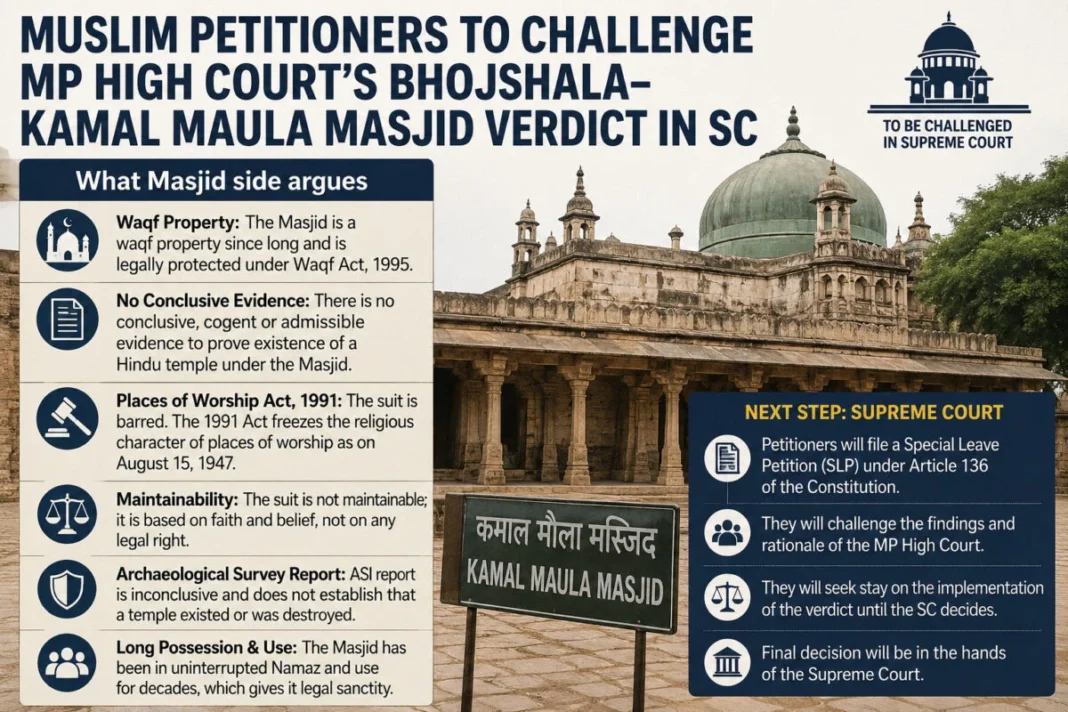


Indore: Rejecting the Madhya Pradesh High Court’s ruling that declared the 11th-century Bhojshala-Kamal Maula Masjid complex a Saraswati temple, the Muslim side has announced immediate plans to challenge the decision in the Supreme Court.
The Indore bench of the High Court on Friday quashed a decades-old April 2003 order by the Archaeological Survey of India (ASI) that had permitted Muslims to offer namaz on Fridays and Hindus to worship on Tuesdays. In a 242-page order, the bench of Justices Vijay Kumar Shukla and Alok Awasthi suggested the state government allocate separate land in Dhar district for a mosque instead. The bench “In order to secure the religious rights of the Muslim community and to ensure complete justice between the parties……the State Government may consider (an application for land) in accordance with law for allotment of a suitable and permanent part of land in Dhar district to the Muslim community, which may be represented either through…..a duly constituted Waqf body for the construction, administration of a mosque and associated religious facilities.”
Giving example of Babri case, HC bench said “We have considered the archaeological, historical facts, ASI notifications and survey report on the anvil of the statutory provisions of the ASI Act as well as on the basis of the principles laid down in the Ayodhya case, that archaeology is a science that draws on multidisciplinary or transdisciplinary approaches and considering the nature of archaeological evidence.”
“Flawed” Survey and Jurisdictional Objections
Ashar Warsi, counsel for the Muslim petitioners, stated that they are entirely unsatisfied with the 242-page judgment, labeling the ASI’s 98-day scientific survey report—upon which the court heavily relied—as “flawed.”
Warsi also raised a critical jurisdictional objection, arguing that a matter involving highly disputed historical facts should not have been adjudicated through a writ petition under Article 226 of the Constitution. Instead, he maintained, it belongs in a civil court, noting that the Muslim side has already filed a lawsuit in a Dhar civil court.
Owaisi Cites Historic Protections and 1991 Act
All India Majlis-e-Ittehadul Muslimeen (AIMIM) president Asaduddin Owaisi strongly condemned the judgment, asserting that the site has functioned as a mosque for 700 years and is a “waqf by dedication.”
Owaisi argued that the High Court erroneously ignored several critical historical and statutory protections:
- The Places of Worship Act, 1991: This law explicitly states that the religious character of any place of worship cannot be altered from what it was on August 15, 1947.
- Historical Gazetteers: The 1935 Dhar State Gazette officially acknowledged the site as a mosque relinquished to the Muslim community.
- Past ASI Records: Official ASI clarifications from 1951 and 1952 maintained its status as a mosque.
“I feel that the Government of India, the Modi government, and the ASI are acting in tandem with the petitioners,” Owaisi alleged, drawing “glaring similarities” between this case and the Babri Masjid dispute.
Reactions and Next Steps
Shahar Qazi Waqar Sadiq confirmed that a formal appeal to the apex court will be filed after a thorough review of the full judgment. Meanwhile, a Hindu petitioner, Jitendra Singh ‘Vishen’, has already filed a caveat in the Supreme Court requesting that no orders be passed without hearing their side first.
Commenting on the development, Congress Rajya Sabha MP and former Chief Minister Digvijaya Singh stated that the Supreme Court must now ultimately decide whether active worship can even be permitted inside an ASI-protected monument. Singh noted that the ruling comes at a time of “economic and social crisis,” adding that it is inappropriate to escalate communal issues when multiple related disputes—including Gyanvapi and Mathura—are already pending before the apex court.
2003 ASI Order