
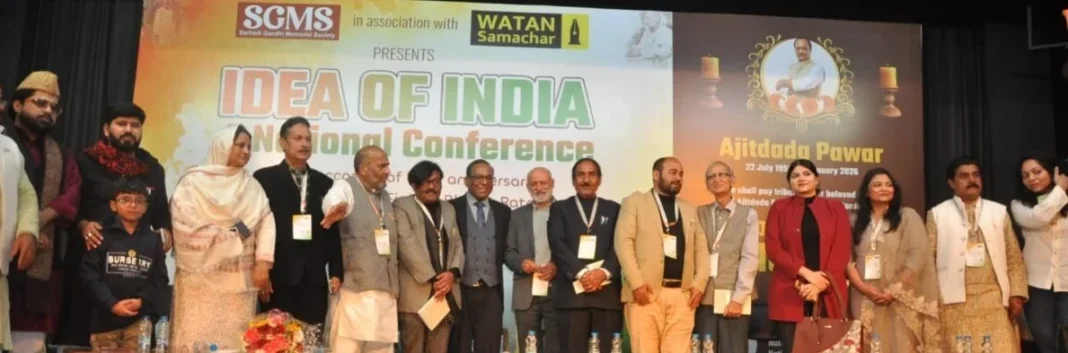


New Delhi: Amid rising communal polarisation and hatred in the country, eminent intellectuals, writers, historians, social activists and human rights defenders urged a renewed commitment to democratic and constitutional values, inclusiveness, social justice, pluralism and communal amity, recalling the legacy of Khan Abdul Ghaffar Khan, popularly known as Badshah Khan or Frontier Gandhi.
The conference was organised at the India Islamic Cultural Centre (IICC) by the Sarhadi Gandhi Memorial Society (SGMS), in collaboration with Watan Samachar, on the birth anniversary of the Bharat Ratna awardee Khan Abdul Ghaffar Khan. The objective of the programme was to advance serious and meaningful discourse on the concept of the “Idea of India,” rooted in democratic, constitutional and inclusive values. Drawing inspiration from Badshah Khan’s ideology and his lifelong commitment to non-violence, the programme focused on reinforcing India’s shared heritage and constitutional ethos.
The conference witnessed participation from renowned intellectuals, writers, historians, social activists and human rights defenders from across the country. Prominent speakers included Prof. Ram Puniyani, Gauhar Raza, Ashok Kumar Pandey, Dr. Ruchika Sharma, Prof. Akhlaq Ahmad, Dr. John Dayal, Advocate Syed Jalaluddin and senior Supreme Court advocate Z. K. Faizan.
Prof. Ram Puniyani, while criticising Union Home Minister Amit Shah, remarked that if names were to be changed, Shah should first remove the word “Shah” from his own name, as the term has Iranian origins.
Historian Dr. Ruchika Sharma said she first learned about Khan Abdul Ghaffar Khan from her grandparents, which later prompted her to study his life in depth. “I discovered that he consistently spoke of unity and brotherhood and was firmly opposed to the partition of the country,” she noted.
Addressing the gathering, SGMS chief and National General Secretary of the Nationalist Congress Party (NCP), Advocate Syed Jalaluddin, said that Frontier Gandhi was among India’s foremost freedom fighters who not only championed Hindu–Muslim unity but also openly opposed the creation of Pakistan. He added that even after Pakistan came into existence, Khan Abdul Ghaffar Khan remained a vocal critic of it. “He firmly believed that the Pashtuns should remain with India under all circumstances and held strong reservations about Pakistan,” he said.
Poet, social activist and documentary filmmaker Gauhar Raza said that all religions must oppose extremism within their own communities, only then could hatred be eliminated. “We must continue to remember freedom fighters like Khan Abdul Ghaffar Khan because they truly represented the idea of India,” he said.
Prof. Akhlaq Ahmad pointed out that Khan Abdul Ghaffar Khan remained imprisoned in Pakistani jails even after India attained independence. Speakers recalled that while addressing the Indian Parliament, he had once said that Indians had forgotten Mahatma Gandhi just as they had forgotten the principles of Gautama Buddha.
At the end of the programme, tributes were paid to former Maharashtra Deputy Chief Minister Ajit Pawar. The event was conducted by Mohammed Ahmad, Editor of Watan Samachar. A large number of people were present on the occasion.