
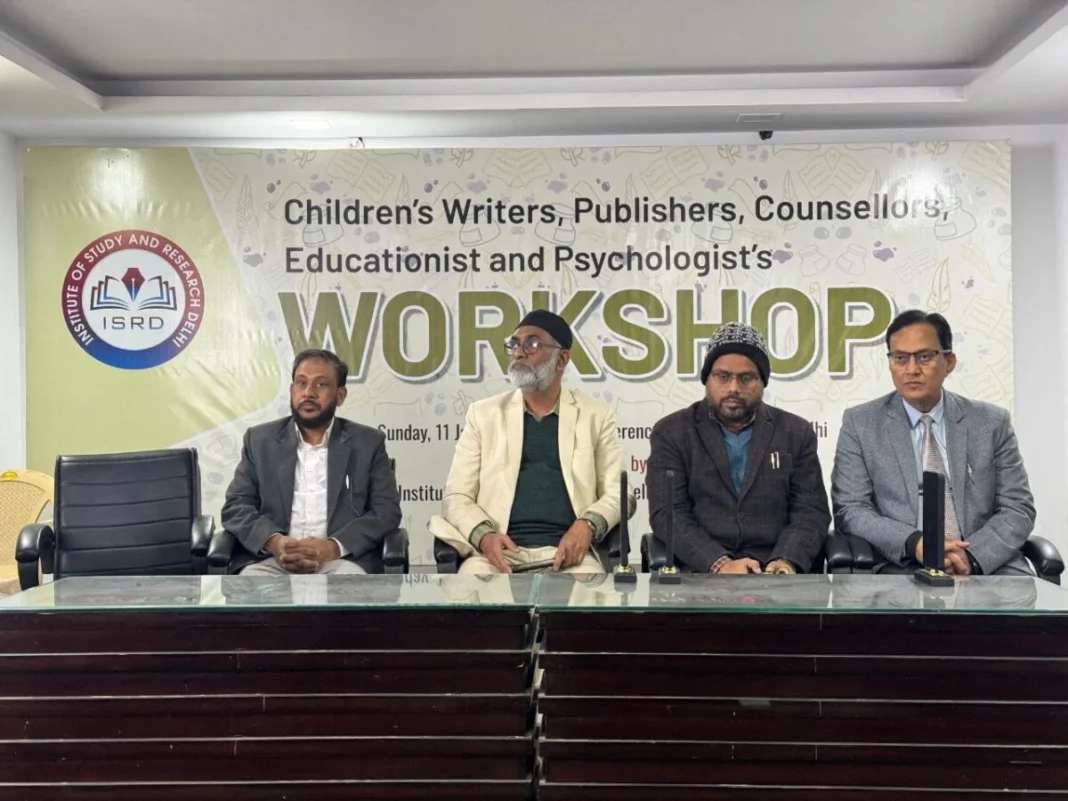


New Delhi: A significant one-day workshop for children’s writers, publishers, and counsellors was organized by the Institute of Study and Research Delhi (ISRD), in which experts and speakers emphasized the urgent need to strengthen moral, religious, and spiritual values in children’s literature in the digital age, while also exploring new literary forms and fresh intellectual dimensions. The workshop was titled “Intellectual, Moral, and Spiritual Development of the Next Generation.” It was attended by children’s authors, publishers, illustrators, animators, counsellors, psychologists, teachers, and media content creators. The participants engaged in serious deliberations on the responsibilities associated with children’s mental and moral upbringing in the digital era.
The workshop stressed that children’s content should not be limited merely to entertainment, but should actively promote empathy, emotional strength, honesty, compassion, social awareness, and spiritual consciousness. Various sessions discussed ethical storytelling, child psychology, character-building, and the responsible transition of content from books to screens. The programme included keynote addresses, panel discussions, hands-on workshops, and collaborative planning sessions. Participants also agreed on laying the groundwork for long-term initiatives such as children’s e-magazines, animated series, mobile applications, literary forums, and value-based publishing projects.
Literature According to Children’s Developmental Stages
Jamaat-e-Islami Hind Vice President S. Ameenul Hasan, focusing on the psychological and moral aspects of writing for children, stated that children’s literature should be developed according to three distinct age groups to effectively address their mental and psychological needs. He explained that the first stage comprises children aged 0–5 years, the second stage 5–12 years, and the third stage 12–18 years (adolescence). According to him, not every writer can write for every age group, as human physical, mental, and psychological development occurs gradually.
The JIH Vice President stated that Allah has created human beings weak and that their development takes place slowly on physical, mental, and psychological levels. While physical maturity is attained naturally, mental and psychological maturity is achieved through quality literature and meaningful writing. Highlighting the responsibilities of children’s writers, he first emphasized lullabies and melodies, which have a powerful and positive impact on children and provide them with emotional comfort. He then stressed the importance of writing and narrating stories, preparing works on the Seerah of Prophet Muhammad (PBUH), and developing Quranic understanding for children.
He cautioned that while writing the Seerah (biography) of the Prophet ﷺ for children, care must be taken not to portray him as a superhuman figure, as this may lead children to believe that such qualities are unattainable for them. Instead, the Seerah should be presented in a humanized and relatable manner so that children feel inspired to adopt those qualities in their own lives.
He further stated that after developing Quran-based content suitable for children’s comprehension, writers should also produce fiction for children. Offering practical tips for children’s writing, he emphasized emotional focus, honesty, age-appropriate language, creativity, adventure, and the inclusion of a light-hearted humorous character whose innocence children can enjoy. He added that stories should present practical and humane solutions to children’s problems.
The JIH leader explained that a story within a story creates a trance-like engagement, drawing readers into a deeper intellectual flow with the writer. He encouraged adopting narrative techniques from Quranic stories and embedding values into storytelling, noting that Islam places great emphasis on values. He also stressed that merely advising children is ineffective in freeing them from gadget addiction and isolation; rather, storytelling is a more effective means to highlight their harmful effects.
Literature, Identity, and Values
CSR Director Dr. Mohammad Rizwan delivered a speech titled “Children’s Literature: Language, Imagination, Moral Development, and Social Understanding.” He explained that literature includes prose, poetry, novels, dramas, and essays, and raised an important question as to whether animated cartoons based on novels or dramas should also be considered part of literature. He highlighted the significant differences between Western and Islamic literary objectives and values, which must be kept in mind. He noted that identity confusion is rapidly increasing among the younger generation, with children questioning who they are and what their identity is. In such circumstances, children’s literature should provide correct guidance and awareness, affirming belief in one Creator who created everything, and explaining the human relationship with God based on divine revelation.
He emphasized that Islamic children’s literature should include core civilizational values such as justice, fairness, courage, compassion, and moral discernment. At the same time, themes like imagination, space, robots, Mars, and scientific fiction may also be explored, provided they remain within ethical boundaries.
Practical Guidance and Technical Aspects
Bachpan Group Secretary Dr. Siraj Azeem, , elaborated on the psychological and intellectual needs of children’s literature, stories, and prose. He provided practical guidance to both authors and publishers on producing engaging and impactful books for children.
NCERT’s Consultant Editor Dr. Parvez Shaharyar spoke on “Children’s Books: Futuristic Design.” He clarified that editing is often mistakenly equated with proofreading, which is a misconception. He explained that book production involves four major domains: editing, production, marketing, and printing.
Counselling and Social Responsibility
JIH Women’s Wing, National Secretary Ms. Shaista Rifaat spoke on “Current Trends, Challenges, and Scope of Counselling.” She stated that the Prophet Muhammad (PBUH) listened to the personal and family issues of both men and women and provided solutions. Following this model, she emphasized the need to listen to people’s problems today with knowledge, empathy, and professional skill. She stressed confidentiality, respect, and empowering individuals to solve their own problems, and encouraged women to acquire professional training in family counselling.
Children’s Upbringing and the Future of Society
In his inaugural address, JIH Delhi Secretary Zahid Husain, stated that children are the architects and future of any nation, making their education and upbringing a fundamental responsibility. He noted that Muslim children today face serious intellectual and cultural challenges. Referring to history, he said that earlier generations produced remarkable literature for children’s moral and intellectual development; however, present circumstances demand expansion and the use of modern media such as cartoons, films, dramas, audio, video, and online platforms. He added that the first phase of this initiative had been successfully conducted earlier, resulting in around 30 individuals actively engaging in children’s literature, and that this workshop marked the second phase of the series.
Concluding Session
ISRD Secretary Asif Iqbal stated that the workshop was especially organised to focus children’s authors in English, Hindi, and regional languages, as well as print and digital publishers, psychologists, counsellors, and representatives of NGOs, schools, and organizations working with children. He emphasized that such programmes respond to the growing need for content that is morally strong, psychologically informed, and socially beneficial.
In his concluding address, Mr. Ameenul Hasan advised writers to read extensively before writing, avoid haste, refrain from writing unless the idea is genuinely new and innovative idea, and expand clarity through study, observation, and discussion. He warned that haste is the greatest enemy of good writing, encouraged repeated revision and peer review, and urged writers to enhance the depth and richness of their work. The programme concluded with the distribution of certificates among participants.