
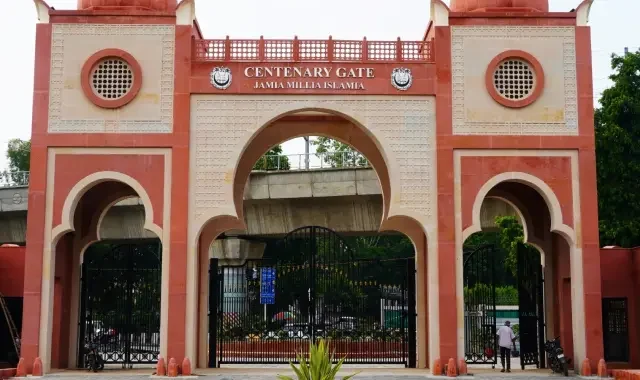


New Delhi: Opposition to the suspension of a professor at Jamia Millia Islamia University (JMI) has intensified, with civil society groups, academics, and student organisations strongly demanding its immediate revocation, terming it an assault on academic freedom.
Professor Virendra Balaji Shahare, a faculty member in the Department of Social Work at JMI, was suspended following objections to a question he set for the BA (Hons) Social Work Semester-I examination held on December 22. The paper, titled Social Problems in India for the academic session 2025–26, asked students to “discuss with examples the atrocities against Muslim minorities in India.”
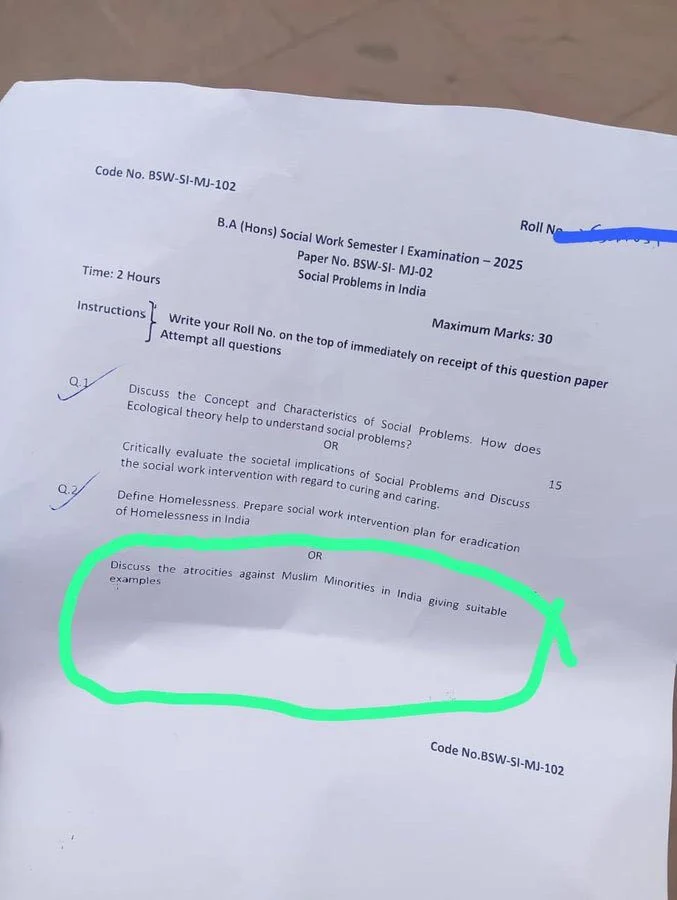
Shahare was the paper setter for the examination.
Suspension Order and FIR Threat
Soon after the examination, the RSS-affiliated student organisation Akhil Bharatiya Vidyarthi Parishad (ABVP) objected to the framing of the question. The group submitted a memorandum to the Jamia administration, demanding stringent action against the paper setters.
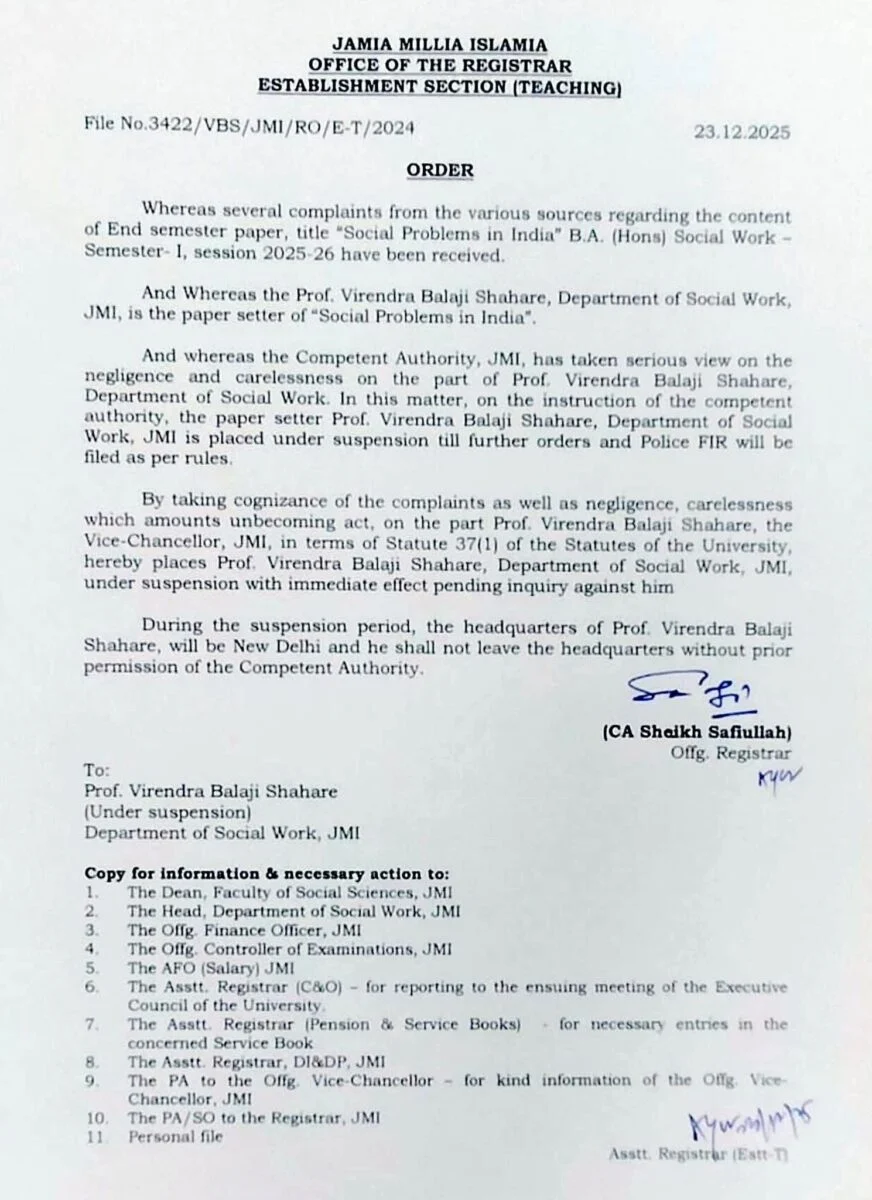
On December 23, 2025, Jamia issued an office order placing Prof. Shahare under suspension with immediate effect. The order, issued by the Officiating Registrar, stated that the university had received “several complaints from various sources” regarding the content of the end-semester paper.
The order accused Shahare of “negligence and carelessness” and said that the competent authority had taken a serious view of the matter. It further stated that an FIR would be filed as per rules. Invoking Statute 37(1) of the university statutes, the Vice-Chancellor placed the professor under suspension pending inquiry.
Student Organisations Unite in Protest, demanding revocation of his suspension
Several student organisations—including AISA, AIDSO, AIMSU, SFI, AIRSO, DISSC, MSF, the Fraternity Movement, and SIO—issued joint statements demanding immediate revocation of the suspension and withdrawal of all punitive actions.
The Fraternity Movement at Jamia declared, “Jamia is not an RSS shakha and it will never be one,” warning of collective resistance if the suspension was not revoked.
The Students Islamic Organisation of India (SIO) said that punishing an academic for encouraging critical analysis amounted to capitulation to political intolerance, while the National Students’ Union of India (NSUI) termed the action a direct attack on academic freedom and university autonomy, asserting that the question was fully aligned with the approved syllabus.
The Jawaharlal Nehru University Teachers Association (JNUTA) strongly condemned the suspension, describing it as “illegal, arbitrary, and an unacceptable policing of academic thought.”
Citing Supreme Court rulings, JNUTA said that negligence or carelessness—even if assumed—does not constitute misconduct warranting disciplinary action. It also pointed out that the suspension order failed to specify any rule violation and relied instead on vague references to unnamed complaints.
Reacting sharply, Delhi University professor Apoorvanand Jha described the suspension as deeply alarming. He wrote:
“This incident reveals the state of the academic world in which we function today. We do not know which sentence or word in our lectures may lead to violence against us, or to suspension or dismissal.”
RJD MP Prof. Manoj Jha said that questions on atrocities against Dalits, women, and minorities were routinely asked in social science examinations.
“You don’t have robots there; you have students,” he remarked.
Journalist Rana Ayyub reacted by saying, “We need to invent a new term for the dystopia we are witnessing in India.”
As condemnation continues to pour in from across the academic and civil society spectrum, the Jamia suspension is increasingly being viewed not as an isolated incident, but as part of a wider pattern of ideological policing in Indian universities—raising serious concerns about institutional autonomy, academic freedom, and the right to ask critical questions.